Invasive Species in Southwestern BC
by Laura Black
Name: Ficaria verna (formerly Ranunculas ficaria)
Common Names: lesser celandine, pilewort, figwort, fig buttercup
Family: Ranunculaceae
Genus: Ficaria
Status in BC: Weed Class B
Reported invasions are in limited areas of Southwestern B.C.
Native to: Europe, Asia & North Africa
Toxic: Humans, livestock
Ecology: Pollinated by bees, small beetles, and flies.
What does Lesser Celandine look like?
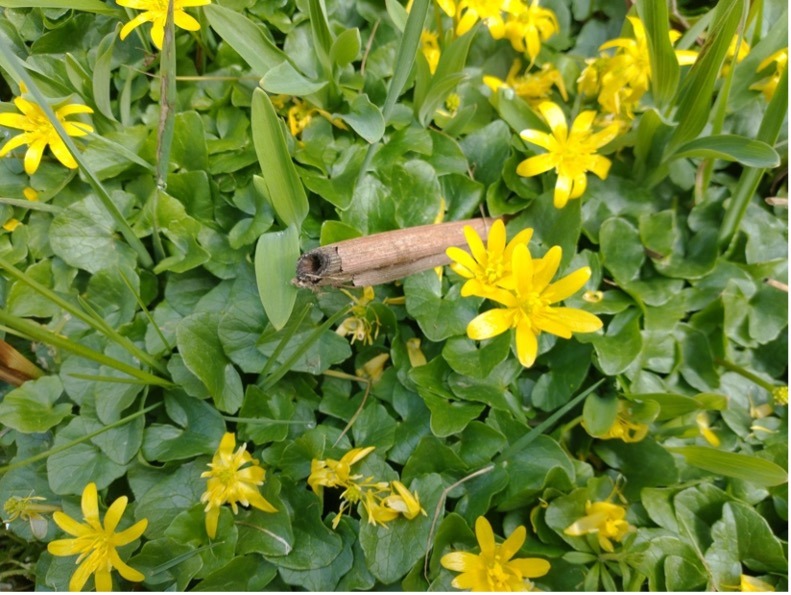
Lesser celandine is a small, low-growing herbaceous perennial, in the buttercup family. It has fleshy dark green heart-shaped leaves and distinctive flowers with bright yellow glossy petals.
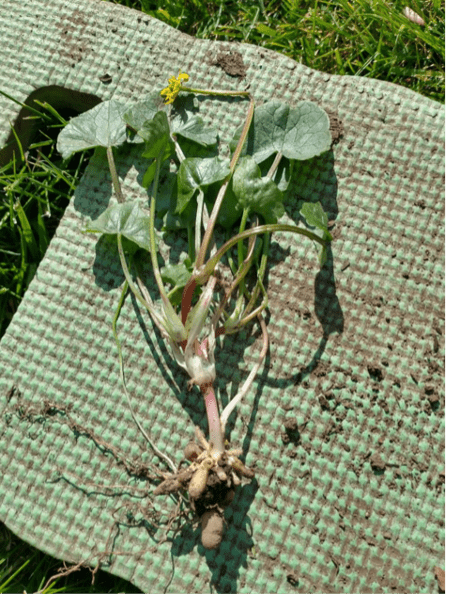
There are 2 types of roots: Dense clusters of thick, pale-coloured elongated tubers surrounded
by patches of short, fibrous roots. Some clumps give rise to long stolons, 10 cm (3.9 in) or
more, allowing vegetative spread to produce extensive carpets of plants.
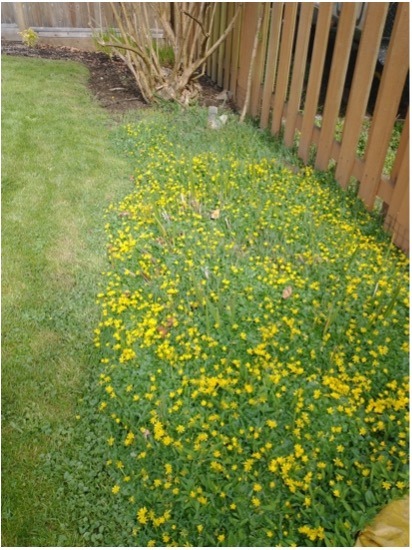
If left alone lesser celandine can take over an entire garden bed and creep into your grass, or neighbour’s yard.
Despite the similarity in the common name, lesser celandine (Ficaria verna) is NOT related to greater celandine, (Chelidonium majus) a plant in the poppy family – however both plants are listed as invasive in British Columbia.
Management of small infestations (1 m² or less):
- Ideally, remove plants before flowering/going to seed in late winter/early spring.
- Dig out plants and remove all the roots/tubers and bulblets.
- Persistence, care and annual management are needed to control this species.
- Mowing is not recommended as it is likely to cause further spread.
- Monitor and manage sites annually until clear.
- Be sure not to remove soil from the contaminated area.
Management of Large Infestations:
Call your local Environmental Coordinator or a professional landscaping company that is well-versed in invasive plant species removal.
Disposal
Currently, the best option is to place all plant parts in a garbage bag labelled “invasive species” and take it to Hartland Landfill. DO NOT COMPOST! Home composting is likely to increase the spread of this species.
To report an invasive plant or weed of
concern:
- Report-A-Weed app: http://www.reportaweedbc.ca
- Report to a provincial Invasive Plant Specialist: www.gov.bc.ca/invasive-species
- https://bcinvasives.ca/take-action/report/
- Call 1-888-933-3722
- http://www.iNaturalist.ca
CRD Invasive Plant Alert Fact Sheet
References
District of Saanich:
https://acrobat.adobe.com/id/urn:aaid:sc:VA6C2:b966d8cb-0c9e-408d-88cb-
87d9aeee1202?comment_id=417b69ea-2751-4802-949a-492bab145e4f
Washington State Noxious Weed Control Board:
https://web.archive.org/web/20160324080851/http://www.nwcb.wa.gov/detail.asp?weed=185
iNaturalist Canada:
https://inaturalist.ca/taxa/204321-Ficaria-verna?locale=en-ca
Field Guide to Noxious Weeds and Other Invasive Plants of British Columbia (p.75)