Some people write about scent: The Scent Keeper by Erica Bauermeister is in my pile of books to read. That reminds me of Air: The Restless Shaper of the World by William Bryant Logan; it’s about aerosols and fogs and microbes. Some people write about sound: I have endless books on music and of music (music being a certain kind of organized sound) on my shelves. Some people write about taste: cookbooks, novels about cooking, such as The School of Essential Ingredients, another Bauermeister novel.
Let’s look at just one of the ways we see nature: through its colours and nature’s progress through fall into winter.
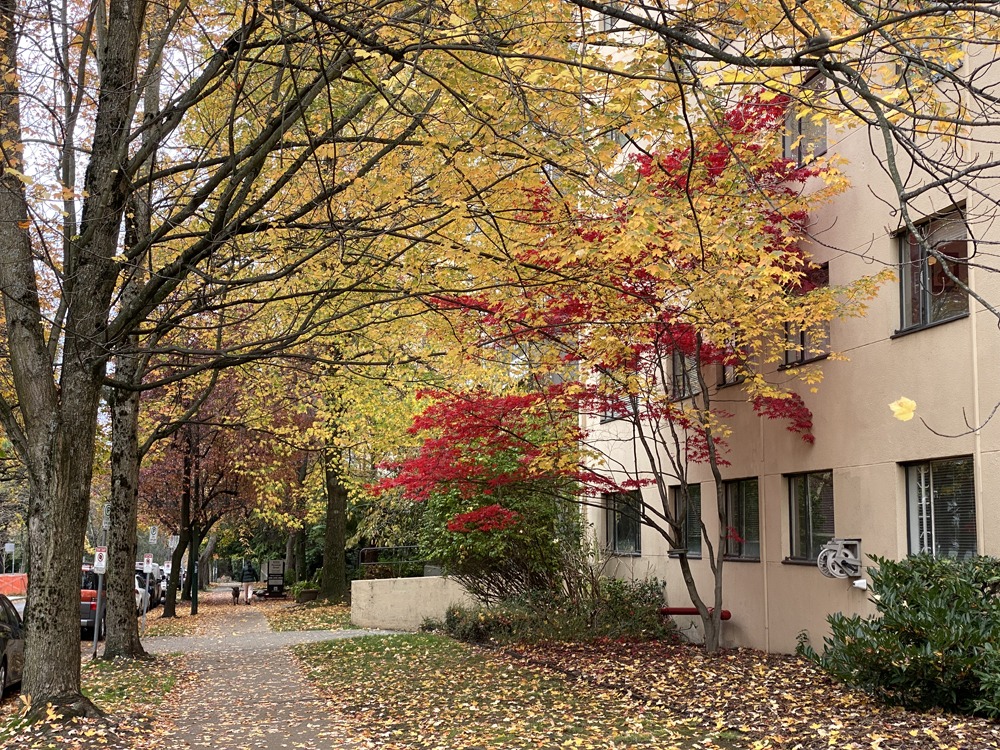
I am walking home after coffee with my sister in early November and I see these branches arching over the sidewalk so that their currently yellow leaves (the trees are Armstrong red maples so they will turn red) are mingling with the scarlet leaves of a Japanese maple.
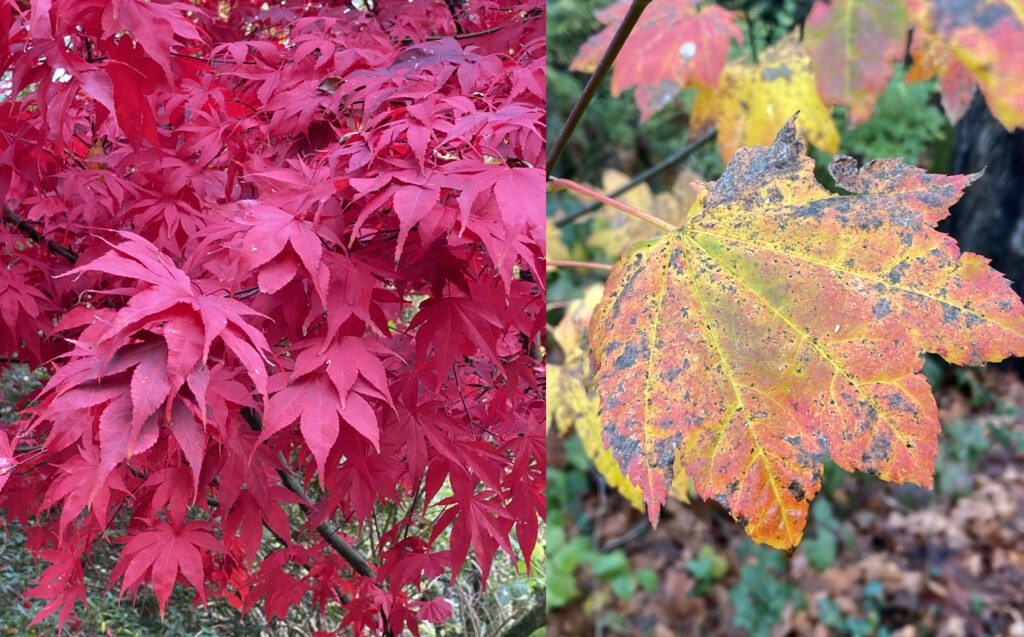
The habit and leaves of three maples are similar: two are from Japan, (1) Acer palmatum, Japanese maple, which is more common; it is in the street scene above and the photo on the left, and (2) A. japonicum, fullmoon maple, less common; and (3) the one that’s native to Canada growing in forest understorey, A. circinatum, vine maple, though not a vine at all! The leaves are palmately lobed, though the Japanese maple’s lobes are longer than those of the vine maple.
A common tree in the City of Vancouver—11,000 of them have been planted along our boulevards—is Prunus cerasifera ‘Atropurpurea’, purple flowering plum.
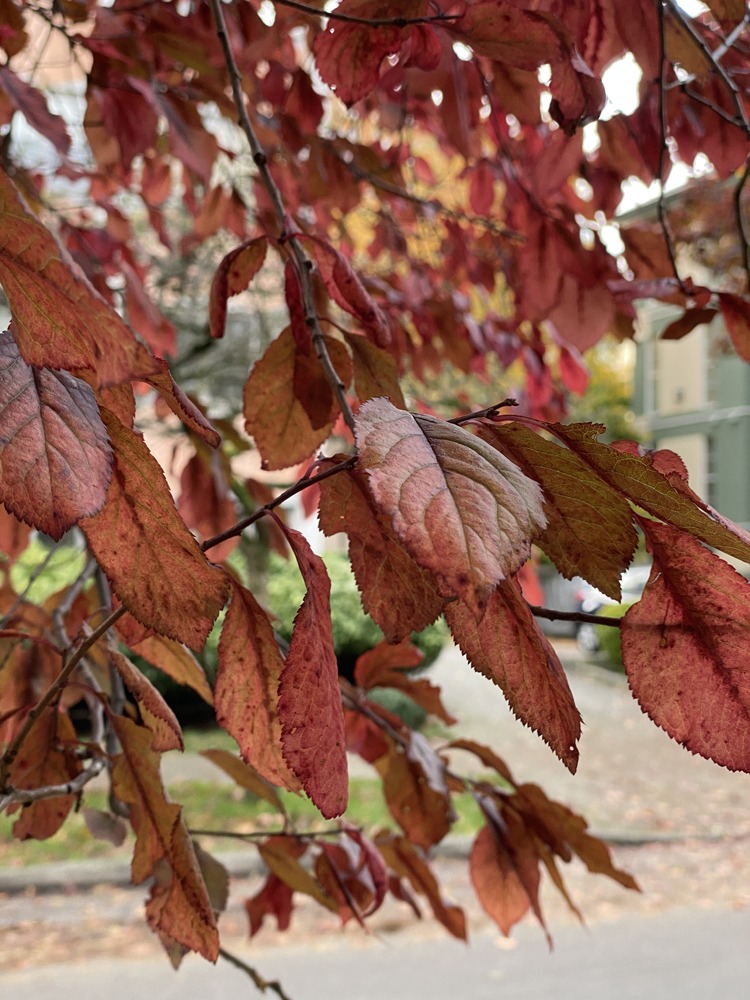
These leaves have lost their colour and are no longer purple, as suggested by the cultivar name, but more auburn.
Hydrangeas display beautiful colours in the fall, if they haven’t been heavily pruned in readiness for next spring. Their showy family is known as Hydrangeaceae.
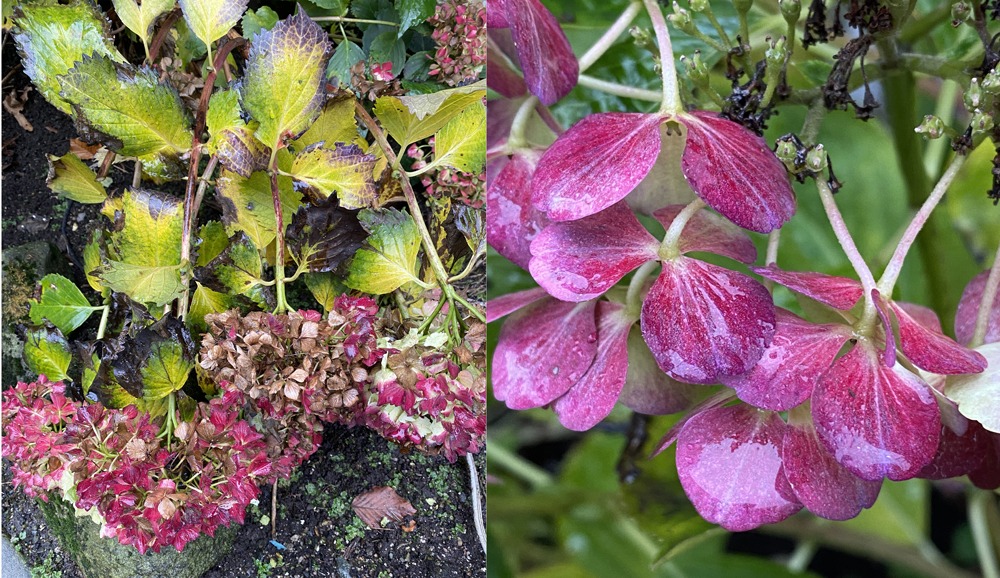
These hydrangea plants grew near each other in a laneway garden. On the left is Hydrangea macrophylla, bigleaf hydrangea. On the right, is a lacecap hydrangea, species name unknown. Its striking fuschia-coloured sterile florets now hang down, their work of attracting pollinators done.
Various fruits are in various stages of maturity.
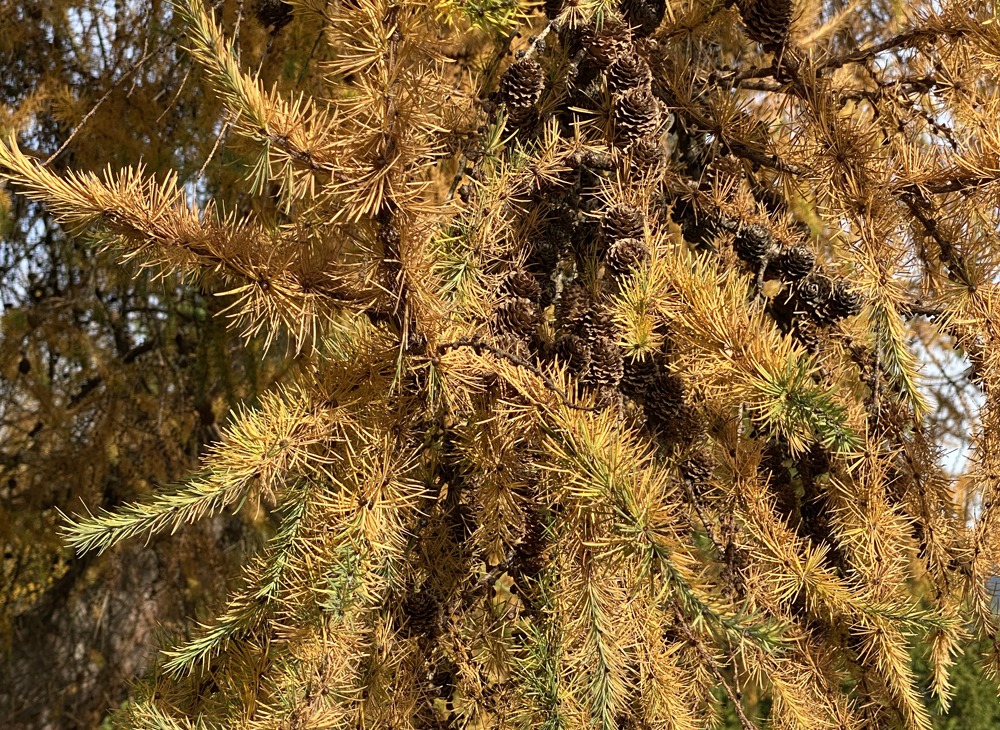
To my eye, these are the prettiest of the larch cones. This tree growing in Stanley Park is a Larix kaempferi, Japanese larch. Its needles in early November are losing their spring and summer green and turning oranges and lemons before falling, leaving behind the seed cones to continue maturing.
Rosaceae, the rose family, has fruit that often look like small apples, fairly recognizable.
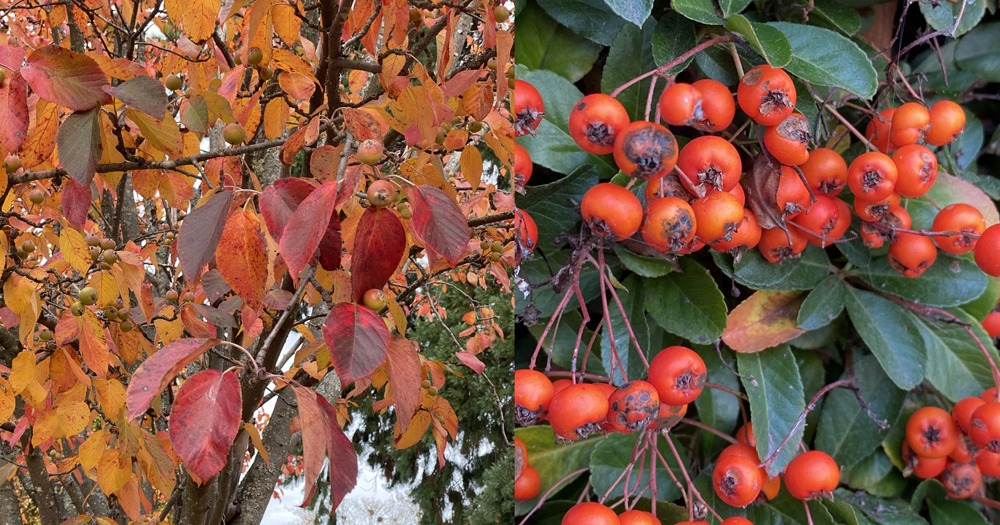
On the left is Malus tschonoskii, tschonoskii crabapple, its leaves turning from gorgeous oranges all the way to deep reds. On the right is a shrub of Pyracantha coccinea, scarlet firethorn, growing as a hedge. This plant is evergreen, sometimes semi-evergreen.
Two more trees with fruit. The first is unusual.
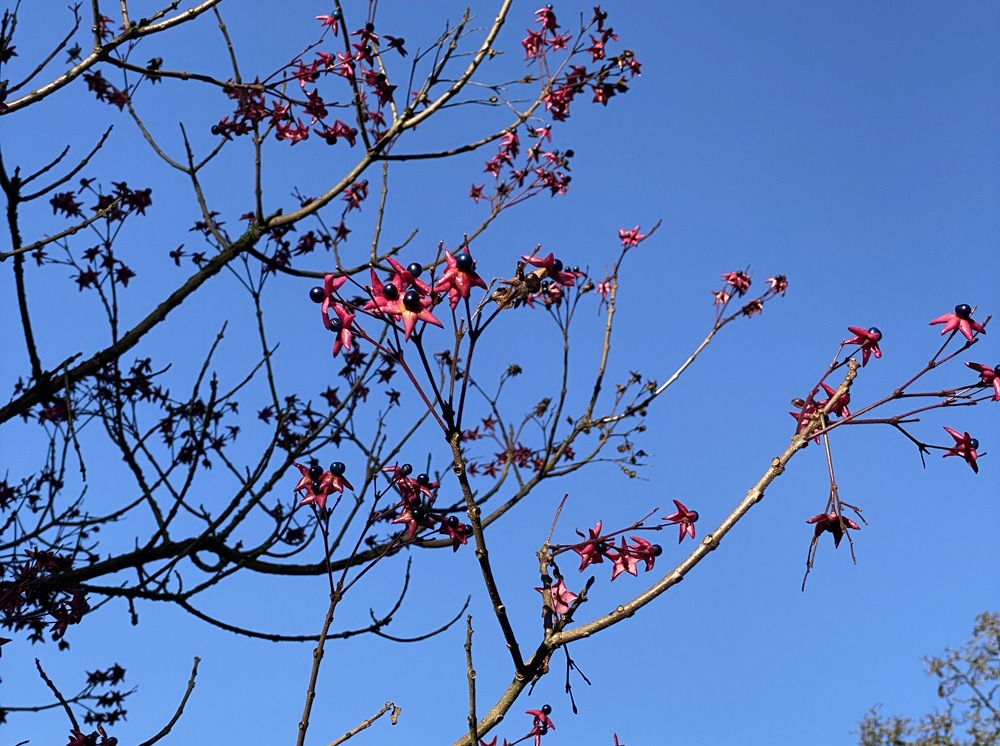
This shrub that’s been pruned to be a tree is Clerodendrum trichotomum, harlequin glorybower. Actually, it is not always glorious! Being surrounded by a calyx of bright pink sepals, the once-blue-now-black fruit are available for the birds to eat the flesh and disperse the seeds.
These berries are still ripening on a native plant in a lane.
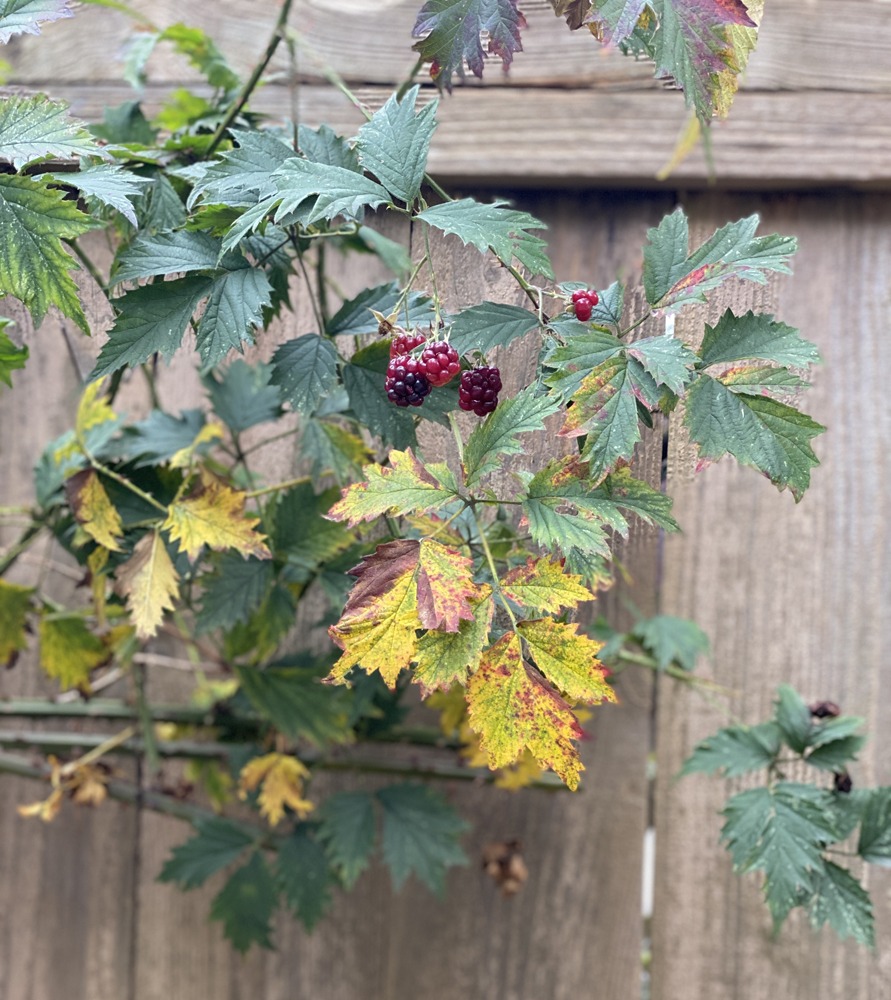
This is Rubus leucodermis, western raspberry, being cultivated in a lane, even though it is native. The still-ripening berries are moving from red to purple and eventually to black.
This time of the year, in November and December, while we wait for the holiday festivities and the new year to begin, flowers are growing.
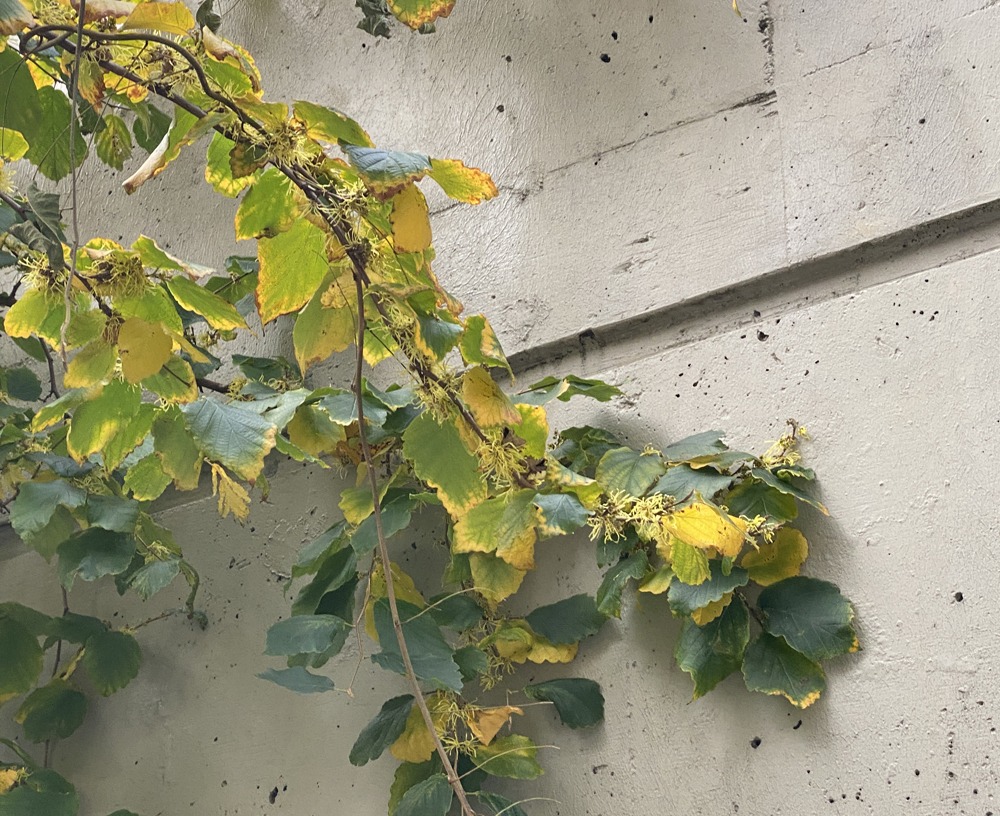
First come the strappy yellow flowers of Hamamelis virginiana, common witchhazel. It is growing in a lane.
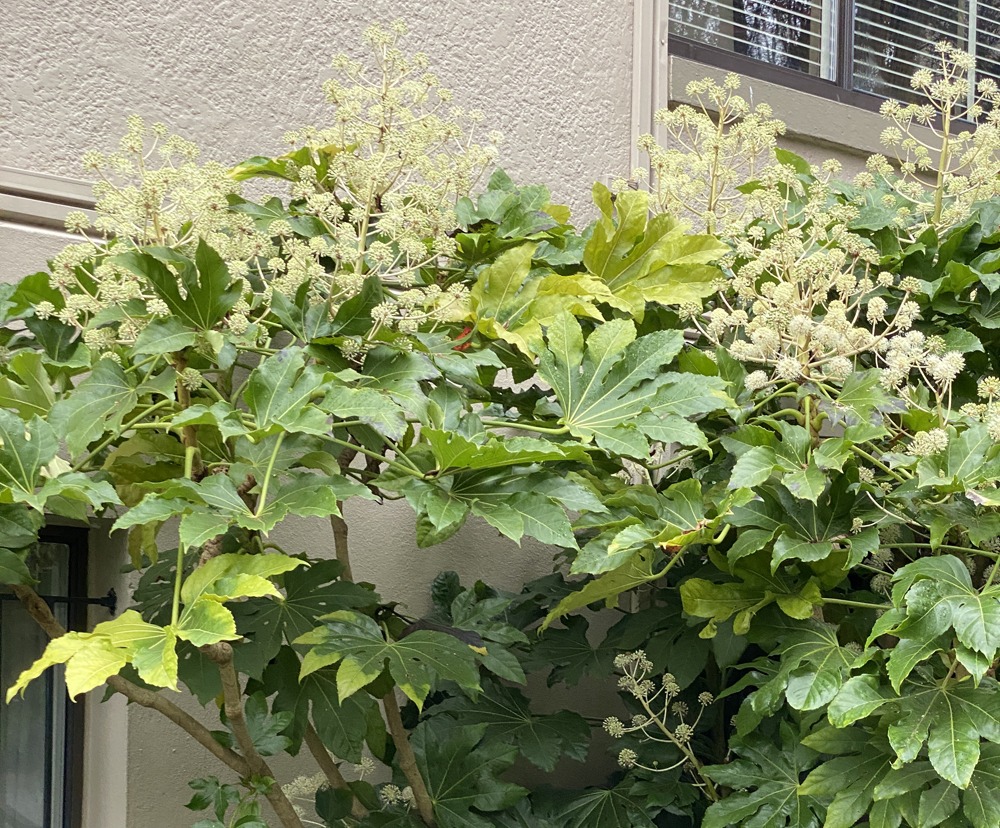
Next are the panicles of cream-coloured umbels of Fatsia japonica, Japanese fatsia. This shrub is in Araliaceae, the ginseng and ivy family, which includes many invasive plants such as English ivy (Hedera), and devil’s club and Aralia elata, angelica tree. The large palmately lobed leaves vary in colour from green to yellow to variegated. Much of this particular plant suffered and froze in last year’s extremely cold temperatures, but it is back to full bloom here in November 2025.
Flowers that bloom in winter are very encouraging.
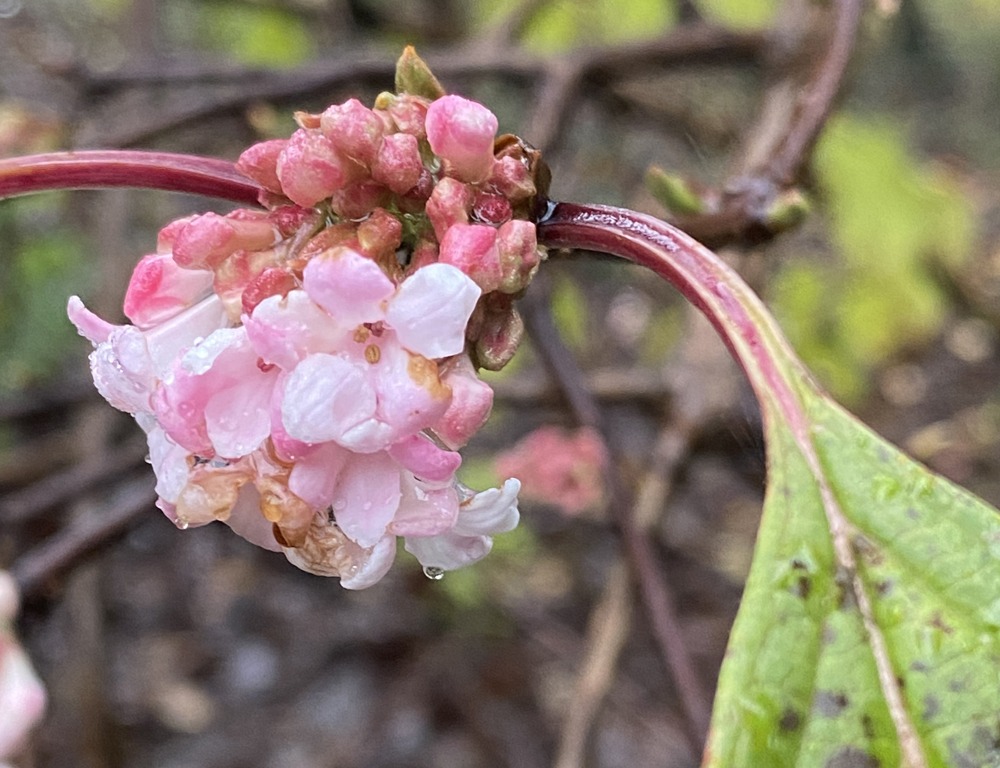
Here is a close-up of a Viburnum × bodnantense, Bodnantense viburnum, in Caprifoliaceae, the honeysuckle family. In it entirety, this inflorescence is no more than about 3 cm. Caprifoliaceae is a family that has opposite leaf arrangement, as can be seen here by the opposite leaf stems. This particular treelike shrub is confusing for a lot of people who think it is an ornamental cherry tree blooming early. But no. One easy way to differentiate the two is that the pink viburnum petals merge together into a tube. Ornamental cherry blossoms are made of five (or multiples of five) separate petals.
So spring is actually coming, even though we might have a snowfall or two before it arrives.
🌱VMG Nina S.