
A hilarious account from one of our 🌱VMG students
Mothers’ Day… and I was slated to work with Doreen M. at Maple Leaf Gardens in Lynn Valley. I arrived, breathless, as there was no parking as far as the eye can see – and I had to risk my life and limb sprinting across Lynn Valley Road. Doreen was already deep into the hugging-everyone-she-knew stage – as she is well-known and respectedin the store: people lined up to say ‘hello’ to her. [She was setting a high bar!].
We had a table and chairs at the entrance to the ‘greenhouse’/indoor plant area that was grand central station on the way to the cashiers. No sooner had I plopped down, that the first question arrived, ensconced in two huge plastic planters.
– “How the *&^^%% do you get these drain holes open?” We tugged and pushed at some knobby looking things.
– “Drain holes? What drain holes? There aren’t any… these are just knobs in this plastic bathtub!”
– “Well, that’s not good… but the planters are the perfect size, look nice and they are good and cheap!” As it is hard to find anything cheap these days, the latter was a great recommendation. Doreen and I looked at each other and asked in unison, “Are they worth it to you at the price they are?” “Sure!” came the response. “Then grab a big nail and a big hammer and make a lot of drain holes… poking the nail from inside the tub, outward so the little flanges go outward.” The questioner was totally on board. “Ok, so once I make drain holes, how does the soil not plug them up?”
Doreen promptly suggested pea gravel, covered by landscape cloth, then adding the soil. Then came the kicker, “What should I plant in there besides vegetables?” Having just read up on companion planting, I proudly suggested calendula and/or nasturtiums and as Doreen didn’t frown, I figured I was on the right track. This seemed to be just the ticket, and the happy customer trotted off to the cashier, picking up seeds on the way.
Well, that wasn’t so bad – I had been expecting some really strangequestions.
The next one was “Where are the flowerpots?” Doreen handled that as I had no idea. .. “Where are the Lobelias…? etc.” Definitely Doreen’s department. A family arrived with 2 huge cedar planters and 2 small children. They too, were concerned about drainage, so the previous answer seemed to serve double duty – also for the flowers.
“Which Lavender is hardy in this climate?” – was easy for Doreen – “Augustifolia...!” I was impressed!
Then came the inevitable “Where’s the bathroom?” This became a Master Gardener Recurring Theme: all those weeks of Basic Training – just to point to the sign above our heads.
Then there was a series of similar sets of people hugging Bougainvilleas or Jasmines – all wanting to plant them outside. Doreen actively discouraged them and suggested bigger pots and the same pea-gravel-landscape-cloth-and-soil arrangement. However, this is where I learned something – she suggested they use sterilized soil! Why? you might well ask… well, because when the plant gets moved indoors, all the creepy-crawlies and bugs that laid eggs in the soil for the next year – hatch in the lovely, heated house and have a field-day! We also suggested that while the plant is living outside, a circular bit of landscape cloth around the stem would not be amiss… to prevent any other critters from depositing eggs.
Doreen tackled – or should I say, she was tackled – by a gentleman who showed her his patchy lawn. Lots of pictures of his patchy lawn. Since I hate lawns with a passion, I didn’t trust myself with that one and cowardly made myself scarce and wandered off to find a dark-shade-tolerant indoor plant (Doreen suggested Calathea) for a small child, When I dared return, Doreen had a smug look on her face and said, “He is considering a lawn alternative!” Wow: she’s good!
Next came another “bathrooms” and several “where is…?”questions.
The easy ones were “Can we plant our veggies outside?” to which we suggested hardening them off for a few days before sending them into the great outdoors. “Can we plant our dahlia tubers?” Right or wrong, I said “yes” as mine are already coming up and I’m at 1000 feet.
Then a young man appeared who was very intent on propagating Eucalyptus cuttings. I never did ask him whether those were the long leaved or the grey round-leaved ones. In any case, I repeated verbatim what we learned about cuttings: 3 nodes – 2 into the ground; pencil thickness, rooting hormone, score 1 inch of the stem on either side at the bottom; patience – and do several in case they don’t work. Fingers crossed.
Then some young men wanted to fill a large pot – so we talked about “Thriller, filler and spiller” – and they decided that veggies were sufficiently thrilling; Lobelias would fill, and Nasturtiums would spill.
Another young man wanted to know whether there were any fruits that he could grow from seed that would fruit this year…. We couldn’t think of any (other than tomatoes, but those were in the veggie category) – but we did try to steer him to some strawberry and raspberry plants. Not sure what finally happened.

Two more “Bathrooms”.
A family wanted to know what succulents were not poisonous to cats. Apparently, their cat is non-discerning and eats everything. My cat just digs in my pots and poops in them – but otherwise leaves the plants alone. Still – there is no accounting for cat taste – so a quick Ecosia search told me that most succulents are non-toxic, except for Aloe, Kalanchoe, Jade plants and pencil cacti. Who knew?
Next was, “What do I plant under my privet and my roses?” No idea. Doreen came to the rescue and explained that roses really don’t like company and it’s pretty dark under a privet. However, as the lady was bound and determined to plant something, anything, and as it was all next to a stone patio – we figured that some creeping thyme might survive near the roses, and creeping Jenny under the privet. Another case of fingers crossed.
A lemon tree was the next object of discussion: it was healthy,burgeoning, had flowers and lots of baby lemons. The owner wanted to know what to feed it so that the lemons would grow big and not drop. We had a confab over this one – and all we could come up with was to give it lots of food – “14-14-14” – and hope for the best. A post hocEcosia search validated this, so we were pretty pleased with ourselves.
A young family showed me their sorry looking fig tree. It was big, old and some of the branches were obviously dead as doornails. They wanted to know why it wasn’t doing the fig thing. We agreed that the tree was indeed looking pretty unhappy. Before making any drastic decisions – because where there is green, there is hope! – so the consensus was that they would cut off the “dead, diseased & damaged” bits and see what happens: maybe it will recover – fig trees are tough. Without knowing whether it was a self- pollinating variety or one that needed a little friend, the fig thing remained unresolved.
Our time was drawing to a close, but an older couple came with alast-minute SOS. They had a big, West-facing deck that was untenably hot in the evening – they couldn’t enjoy it. They didn’t like awnings, shades, umbrellas but wanted a living wall. They were looking for tall, but bushy trees. We figured those would be expensive and slow, so we came up with a radical solution: build a tall trellis – from those trellis panels that one can find at Rona – and run up some fast-growing Wisteria or climbing hydrangea or virginia creeper on it. This idea seemed to do the trick and they headed off, happy.
As did we.
… and we heard behind us, “Where did you say the bathroom was?”
- Student 🌱VMG Maria I.
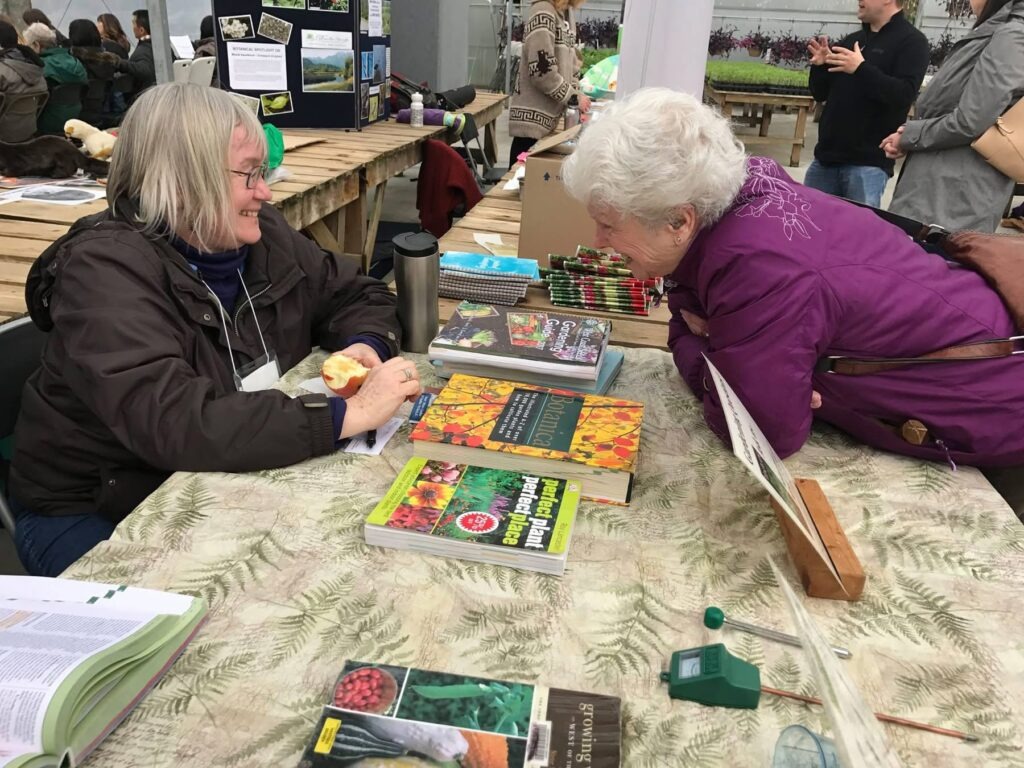
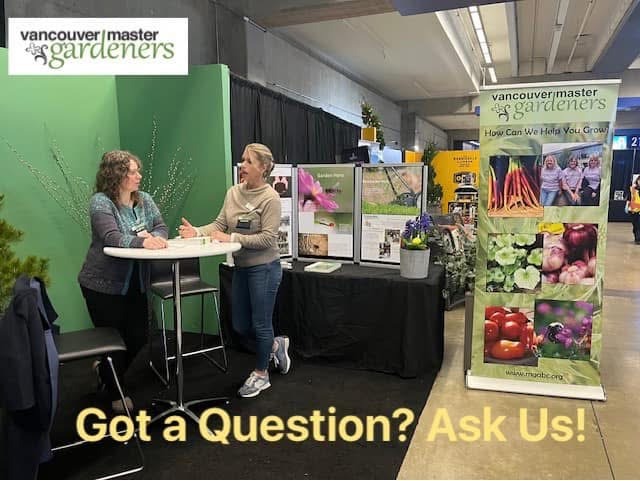
- please note photos used are unrelated to Maria’s experience however they are related to our Volunteer work with the public.