Forty thousand street trees in the Rosaceae Family romance Vancouverites in a blossom parade every year.
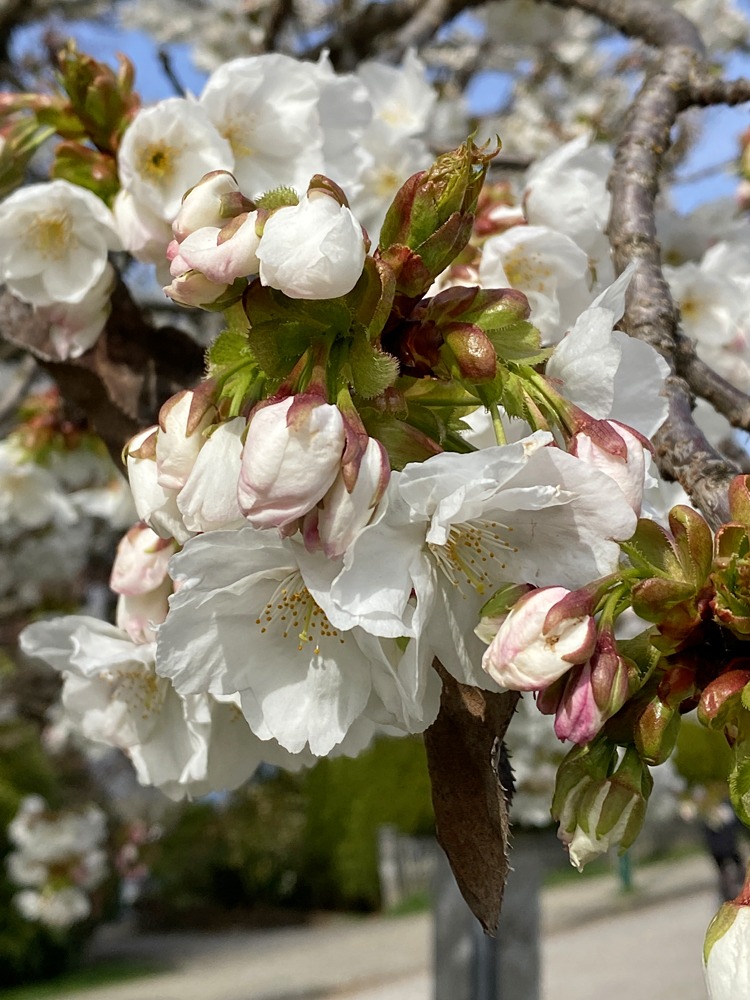
Rose family trees provide a sensory gift with their aromatic, delicate, white, pale pink, ruby red, and vivid crimson buds and blossoms and their leaves that range from pale green through to forest green. Like so many others, I have been observing and photographing this blossom parade for years. Let me share my findings with you.
Pronounced row-zay-see-ee, Rosaceae is “the third most economically important” plant family in the world, according to Britannica.com. The City of Vancouver makes its 148 thousand street trees searchable and mappable by genera, species, age, size, and location. Of the ninety-plus Rosaceae genera, five genera are planted as various species of Vancouver street trees.
Listed by frequency of planting they are
- Prunus (stone fruit, including ornamental flowering cherry and plum trees: 30,438 trees)
- Malus (apple and crabapple: 4,120 trees)
- Crataegus (hawthorn: 3,872 trees)
- Pyrus (pear: 2,232 trees)
- Sorbus (mountain-ash: 1,646 trees)
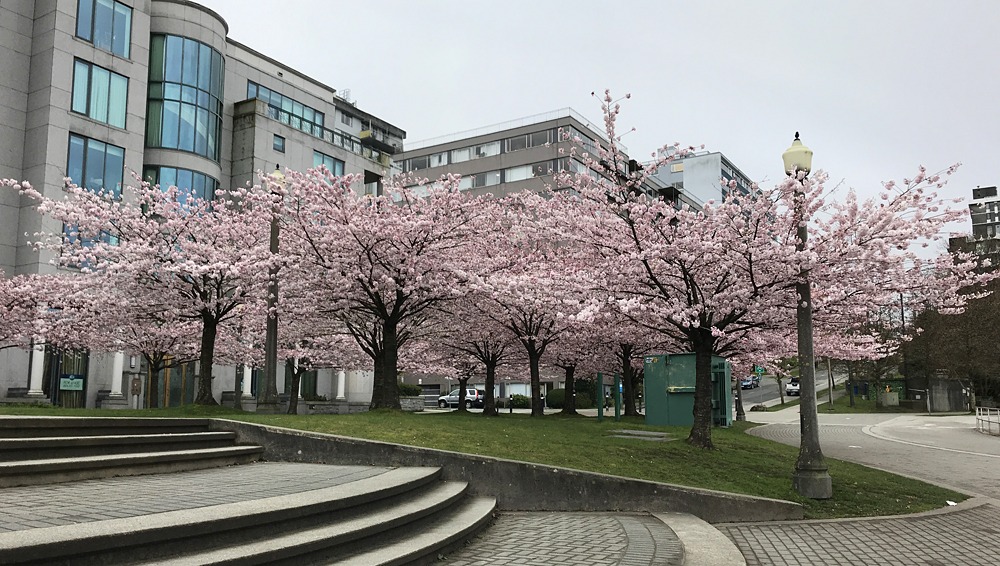
As is evident by the numbers planted, flowering cherry blossom trees seem to be especially valued by the Vancouver Park Board (VPB), frequently being planted in small and large groups in mini-parks and parks; the VPB seldom plants trees that are not cherry blossoms in groups, but rather plants them in straight lines, as boulevard trees for entire blocks.
In addition to the forty thousand Rosaceae Family boulevard trees, uncounted thousands more Rosaceae Family tree and shrub species are tended in Vancouver’s parks, lanes, and private yards.
A few determining features make a plant in the rose family recognizable:
- flowers have a minimum of five petals (or ten or fifteen or more) and five sepals
- flowers are perfect, having both female pistils and male stamens
- flowers have a hypanthium, which is the swollen fusion at the base of the petals, sepals, and stamen filaments
- stems often have thorns (think roses, brambles, hawthorn)
- leaf margins are frequently serrate
The Rosaceae tree parade begins in every city and town in the Pacific Northwest in January with early flowering cherry blossoms, and moves through flowering plums (a.k.a. cherry plums or myrobalan plums), mid-season flowering cherry blossoms, pear trees, crabapples, hawthorns, late-season flowering cherry blossoms, and ends with mountain-ash.
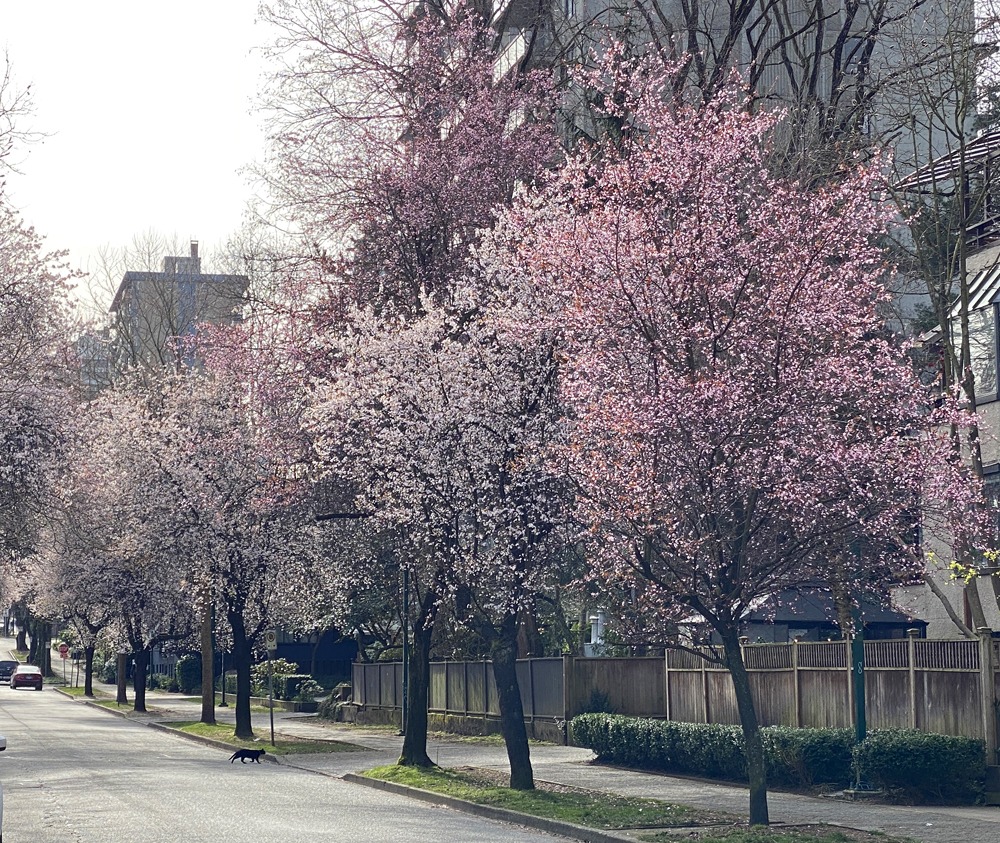
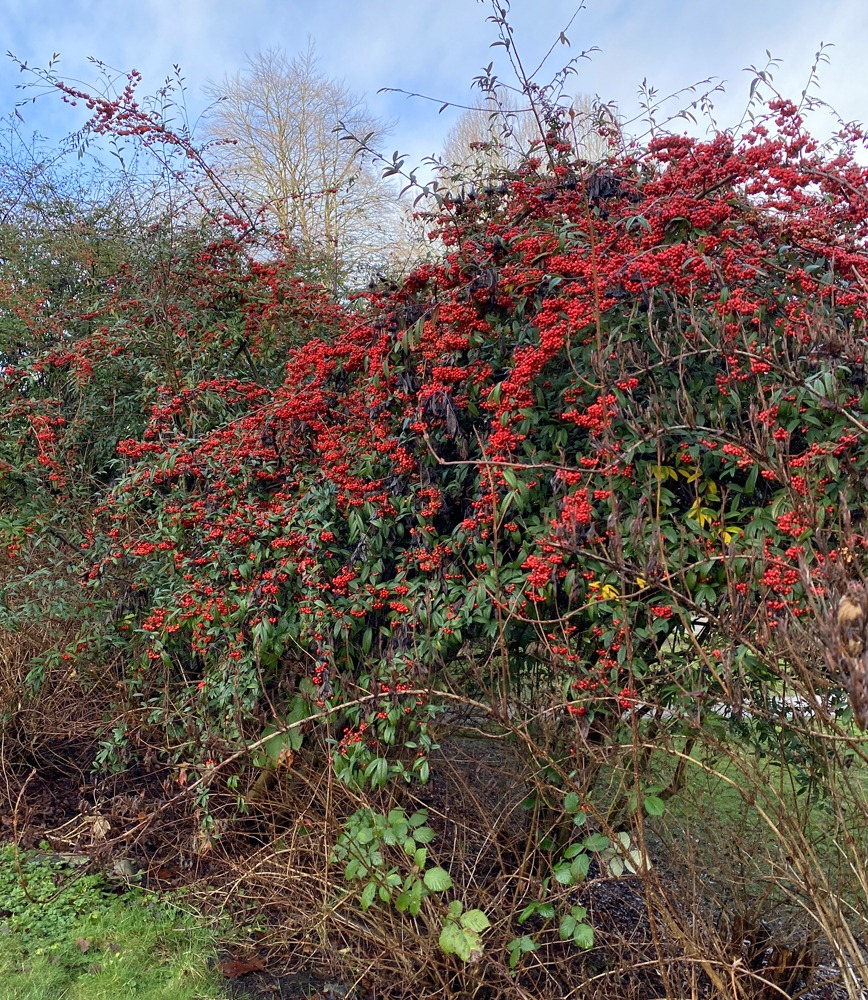
The change of leaf colour from green to burgundy and maroon (plum trees) and green to apricot, orange, terracotta, and sienna (cherry trees, crabapples, hawthorn, mountain-ash) provides more appeal. When pollinators such as bees gather nectar and opportunistically kick-start the fertilization process from flower to fruit, they extend the colourful Rosaceae season to the end of the year. Evergreen trees and shrubs in the rose family—for example, some species in Cotoneaster, Photinia, and Rosa—provide a backdrop of hunter green that offsets the yellow, orange, and red fruit. The types of fruits in this family are various:
- drupes (such as stone fruit),
- drupelets (aggregate fruits such as blackberries and salmonberries),
- haws (hawthorns and roses), and
- clusters of pomes (such as apples and mountain-ash).
Here’s how my personal Rosaceae Family plant journey went this year.
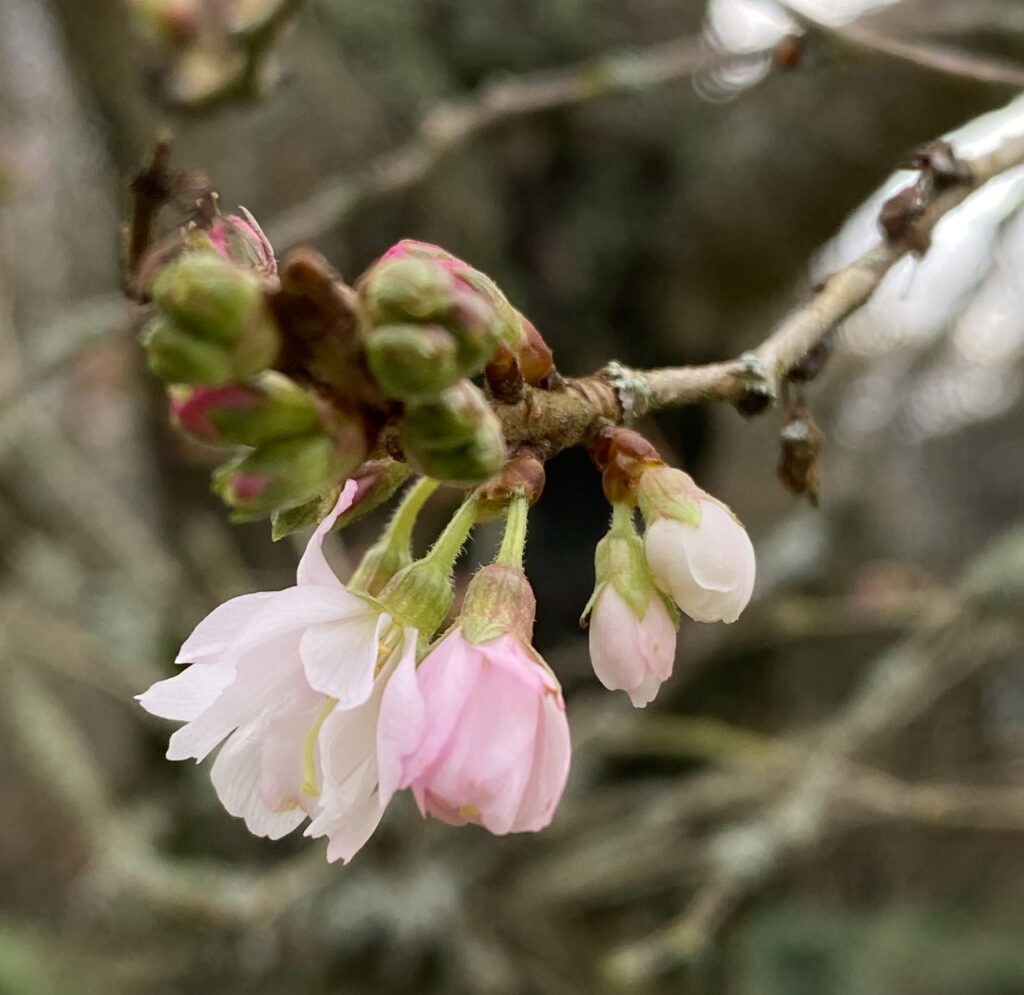
On January 7, I photographed blossoms of Prunus subhirtella ‘Rosea Autumnalis’ in Stanley Park, the peninsula of land that comprises Vancouver’s largest park. ‘Rosea Autumnalis’ is a late-winter (a.k.a. early blooming) cherry blossom cultivar. On February 13, I photographed more ‘Rosea Autumnalis’ blossoms with snow on them. They look bedraggled, yet the tree carried on in its usual way, sending out a few blossoms each warm day.
I did some guerilla gardening in mid-January in the West End on a Prunus subhirtella ‘Whitcomb’, an early blooming cherry blossom cultivar. This particular Whitcomb grows in a no-man’s land between pavement on one side and an uncared-for parking lot on the other. It was overgrown with English ivy (Hedera helix); it was suffocating! I took pity on it. With my sharp secateurs, I chopped at that ivy shroud until it started falling away, revealing half the trunk and the lower half of its only branch, a curved one that reaches for the sky. Next time I went by, I saw that someone else had finished the job I had begun and the tree bark was enjoying the sunshine for the first time in years. That tree started blossoming in late January and continued vigorously for months.
In March, I inserted photographs of my guerilla ‘Whitcomb’ cherry tree in a children’s story I write regularly. When the plum trees started blossoming a bit later, I inserted photos of them in a story.
On April 1, I heard that I had passed my Master Gardener Basic Training exam, thanks to great mentoring and assignment marking by Liz K. and Angela H., and the fabulous twice-weekly Zoom-based programs and lectures organized by Aline B. and Susan C. and delivered by the excellent speakers they sought out. The next hurdle, before I can be called a Master Gardener, is the completion of the volunteer hours. Sixty-five of them! Rather tricky in this year of Covid with no farmers markets to attend, where Master Gardeners can normally bring along their information, set up a clinic table, and answer tricky gardening questions from the public.
For now, I’ve chosen the volunteer opportunity called “Content Creation,” writing about trees and plants. For me, a writer, this is perfect. My first Master Gardener article was “A Row of ‘Snow Goose’ ”; ‘Snow Goose’ is a cherry blossom cultivar.
Wendy Cutler, cherry scout coordinator for the Vancouver Cherry Blossom Festival, asked me whether I would like to be filmed in April doing a Stanley Park cherry walk; I first became a cherry scout last year. I said I would, so I spent the next while deciding which would be the right day to catch the most cherry trees in full bloom. Not pre-bloom or post-bloom. Full bloom.
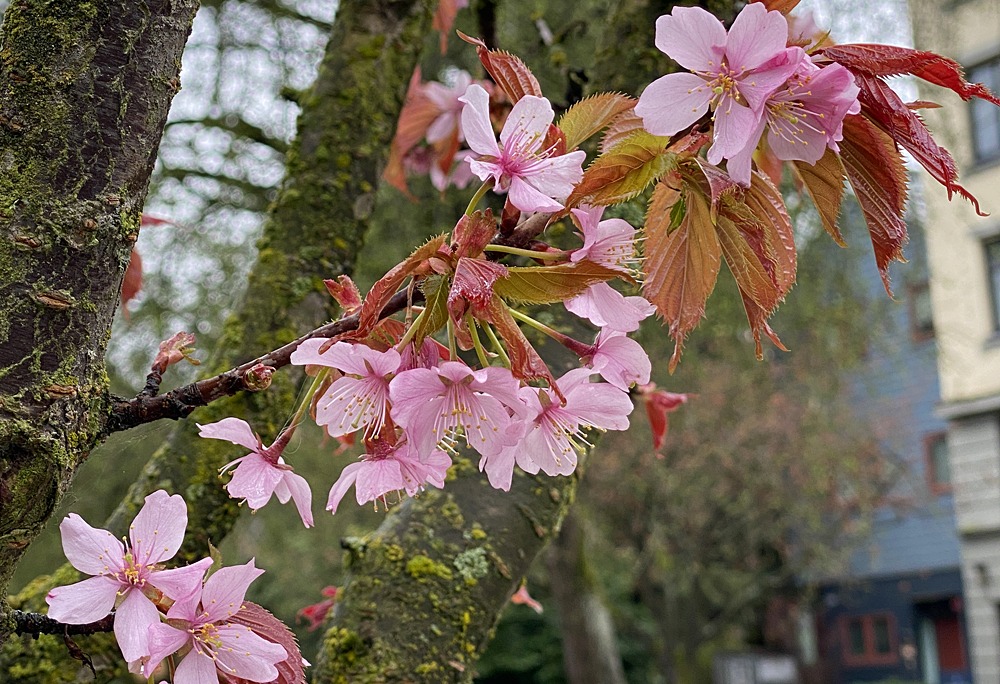
I finally plumped on April 9, and bloom and weather were ideal for Keith Blackmore and Kuni Iwato to film me sharing my knowledge about the cherry blossom cultivars Prunus ‘Somei-yoshino’, ‘Akebono’, and ‘Shirotae’ that grow in various Stanley Park locations. Tall and upright ‘Spire’ and ‘Rancho’ cultivars were also in bloom. ‘Takasago’, ‘Ojochin’, ‘Kanzan’, ‘Gyoiko’, and ‘Shiro-fugen’ cultivars were only reaching bud stage.
Spurred on by the idea of picnicking under a cherry blossom tree, the next children’s story I wrote was “A Mount Fuji Hanami,” which translates as “a picnic under a ‘Shirotae’,” a cherry cultivar also known as the Mount Fuji cherry tree.
April was also when crabapple, hawthorn, and mountain-ash trees joined the cherry blossom parade with a splash of new colour.
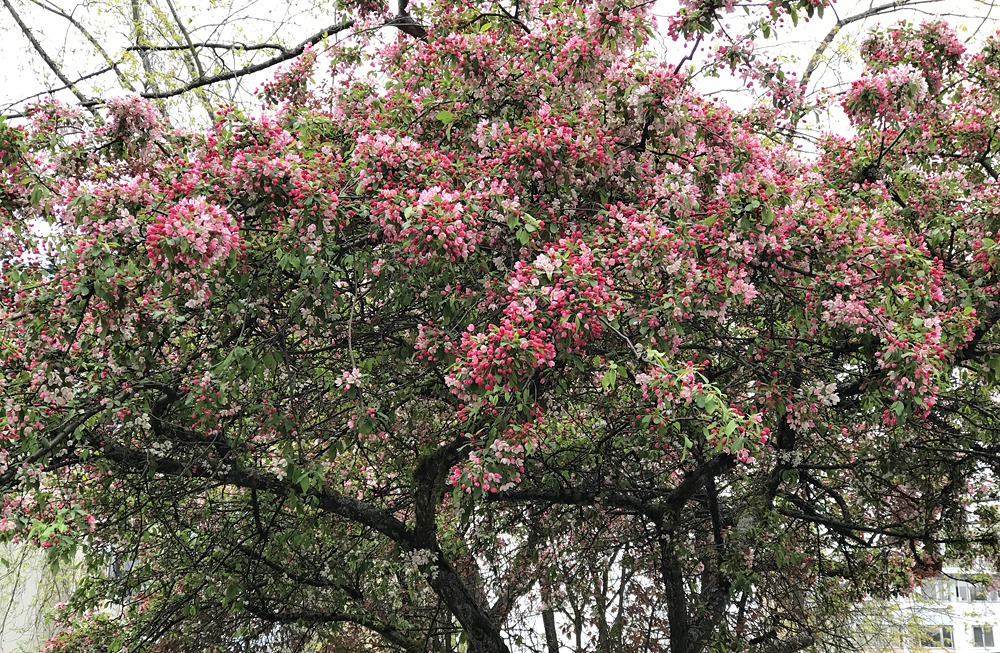
Sometimes crabapples make our streets colourful.
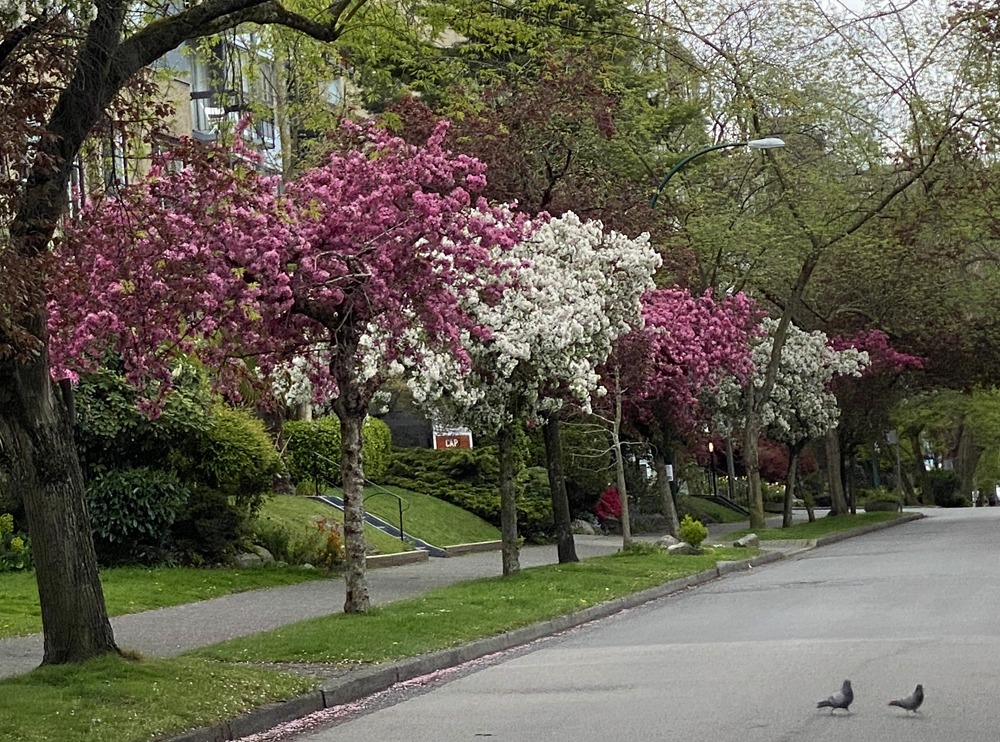
The delicacy, pink shades, and profusion of their perfect (both botanically and visibly), tiny flowers always draw me in.
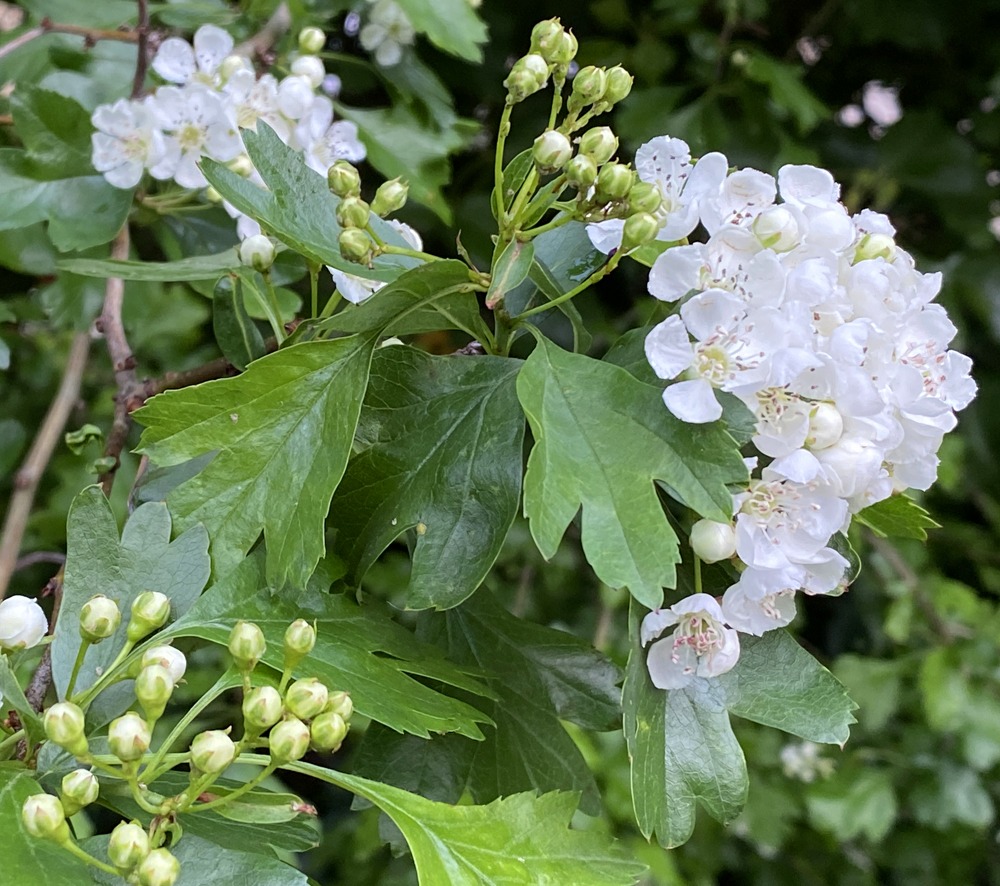
Leaves on some plum blossom trees were darkening to their summer shade of maroon. Such shrubs as Cotoneaster, Photinia, Spiraea, and Prunus laurocerasus (cherry laurel), other Rosaceae genera, joined the eye-candy spectacle. Our city was alive with blossoms.
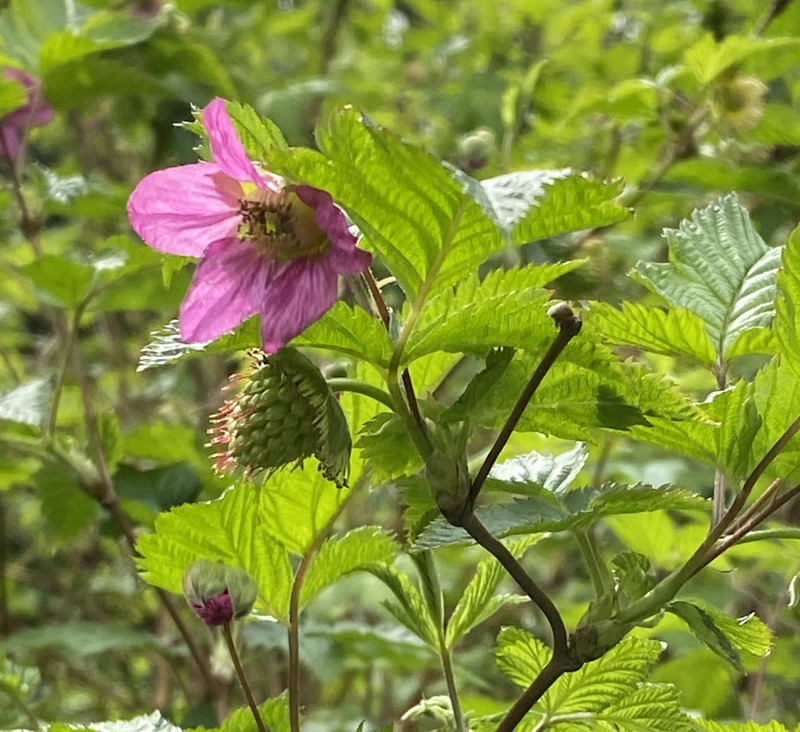
When I walked in the woods in April, I saw the delicate, hot-pink petals of salmonberry flowers accomplishing their task of attracting pollinators; in late April the green aggregate fruit were becoming evident. The Latin name for salmonberry brambles is Rubus spectabilis and it too is a member of the Rosaceae Family.
By June, the beauty, charm, and joy of the blossom parade on Rosaceae Family trees was mostly over. It has been fruitless as usual, but never futile—fruitless with cherries, plums, and crabapples, but it will be fruitful of a myriad of clusters of yellow, orange, and red umbels of pomes, haws, and berries that are attractive to birds.
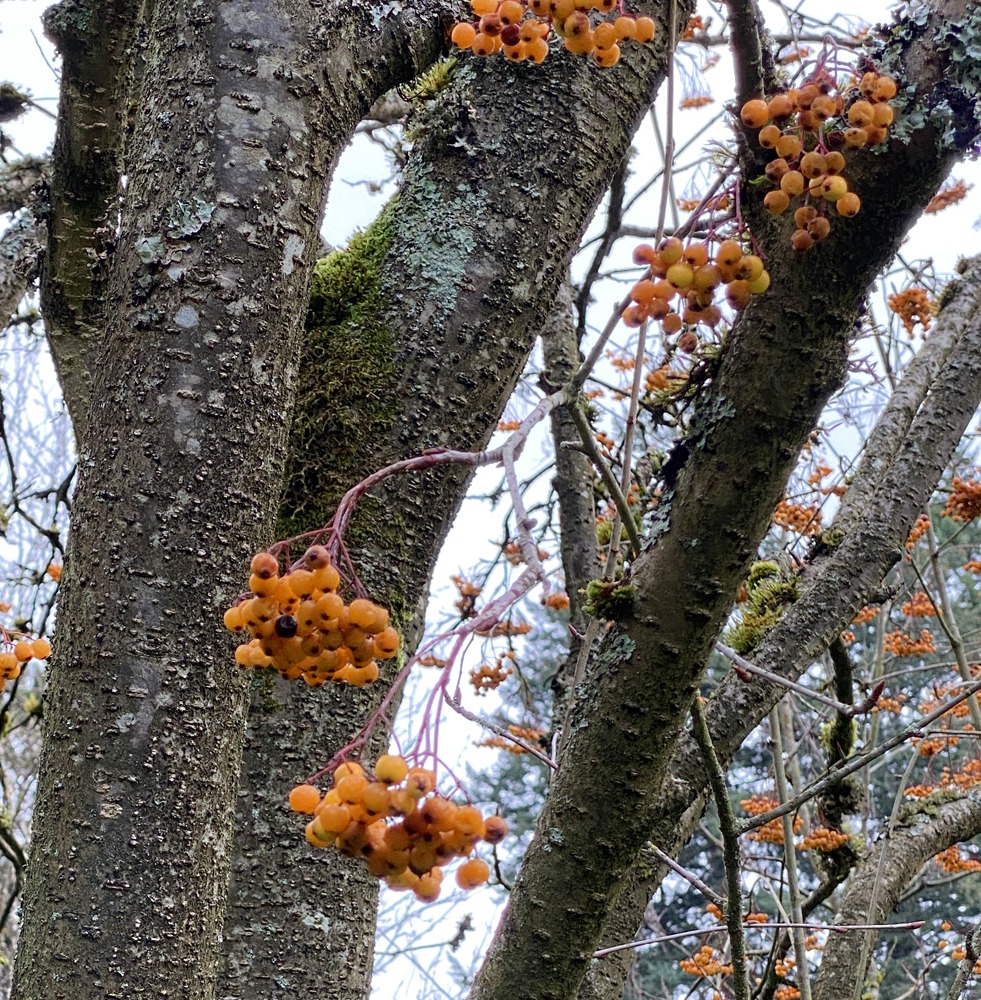
These fruits hang around until winter, their bright colours tiding us over until the parade begins again next year. Meanwhile, native brambles of the rose family offer up the year’s fruit, thanks to the busyness and business of pollinators.
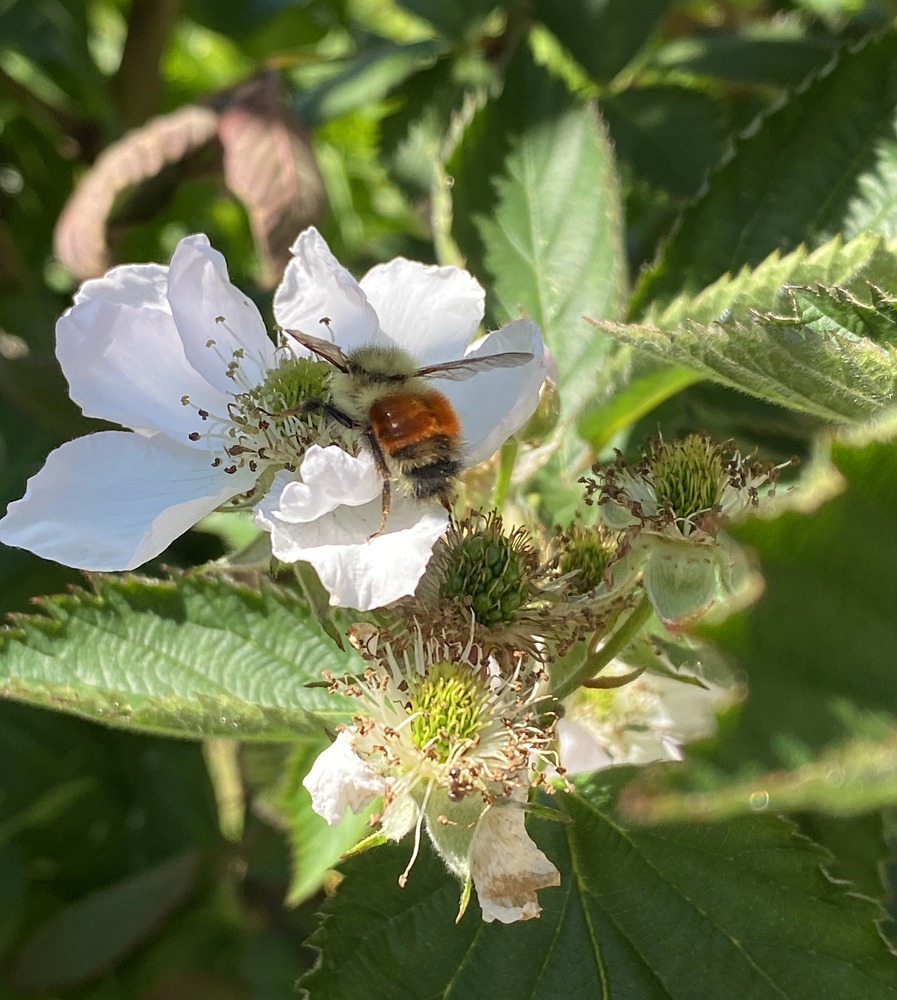
The first half of 2021 has been rosy. Now the shrubs and woody herbaceous plants such as Cotoneaster, Photinia, and cherry laurel don’t just overlap the tree blossoms; they take over.
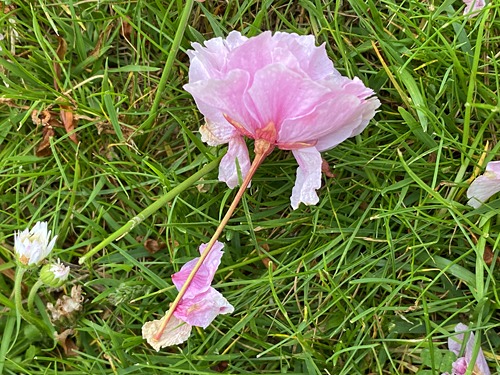
Also, at about the time the last tree petals fall, covering the ground with pink and white petals, the genus of Rosa—the genus from which Rosaceae gets its name—bursts into florescence, thrilling our sense of sight and occasionally our sense of smell. In gardens and parks everywhere are roses of every kind, colour, and cultivar in traditional, formal plantings and also casually, romantically, welcoming us home.
Rosaceae is an endearing family! While I have had to keep my distance from my own family, I have been able to get up close and personal with Rosaceae.
What’s ahead? A Bartlett pear with breakfast every morning. Vancouver’s annual UBC Apple Festival in October. Until then, quince jam on toast. A tot of sloe gin made from the fruit of Prunus spinosa some lazy afternoon? Strawberries, anyone?
🖋️& 📷 Nina S.