WHAT IS XERISCAPE?
Xeriscaping is a science-based, water-efficient approach to landscaping that reduces outdoor water use while supporting biodiversity, soil health, and long-term resilience. When properly designed and maintained, xeriscape gardens can reduce irrigation demands by up to 50 per cent compared to traditional lawns. Without sacrificing beauty or colour.
WHY XERISCAPE?
The Thompson–Okanagan region lies within a semi-arid rain shadow. In Kamloops’ hot, dry summers (average ~21.8 cm annual rain), outdoor residential water use is dominated by lawn irrigation. Municipal estimates show that a xeriscape garden often uses about 50 per cent or less of the water that a traditional lawn requires when designed with drought-tolerant plants and efficient irrigation.
* Sources: Environment and Climate Change Canada: https://climate.weather.gc.ca City of Kamloops: Kamloops.ca

HOW TO XERISCAPE
Transitioning to a xeric landscape does not need to happen all at once. In fact, starting small is often the most successful approach.
Why start small?
o Builds confidence
o Reduces water use right away
o Allows you to test plant choices
o Spreads cost over time
Ways to start small
- Convert One Lawn Strip
- Replace a narrow turf area (boulevard, fence line, side yard) with:
- Mulch
- 3–5 drought-tolerant perennials
- One structural shrub
- Replace a narrow turf area (boulevard, fence line, side yard) with:
- Create a ‘Pilot Project’ Water-Wise Bed
- Remove a small section of lawn (e.g. 2×3 metres)
- Install drip irrigation and group low-water plants together
- Remove a small section of lawn (e.g. 2×3 metres)
- Reduce Turf to Functional Areas
- Ask: Do we use this lawn?
- Keep play areas. Convert unused edges
- Ask: Do we use this lawn?
- Mulch First
- Add 5 to 8 cm (2-3 inches) of coarse mulch to existing beds
- Mulch reduces evaporation and improves soil health
- Add 5 to 8 cm (2-3 inches) of coarse mulch to existing beds
7 Principles of Xeriscaping
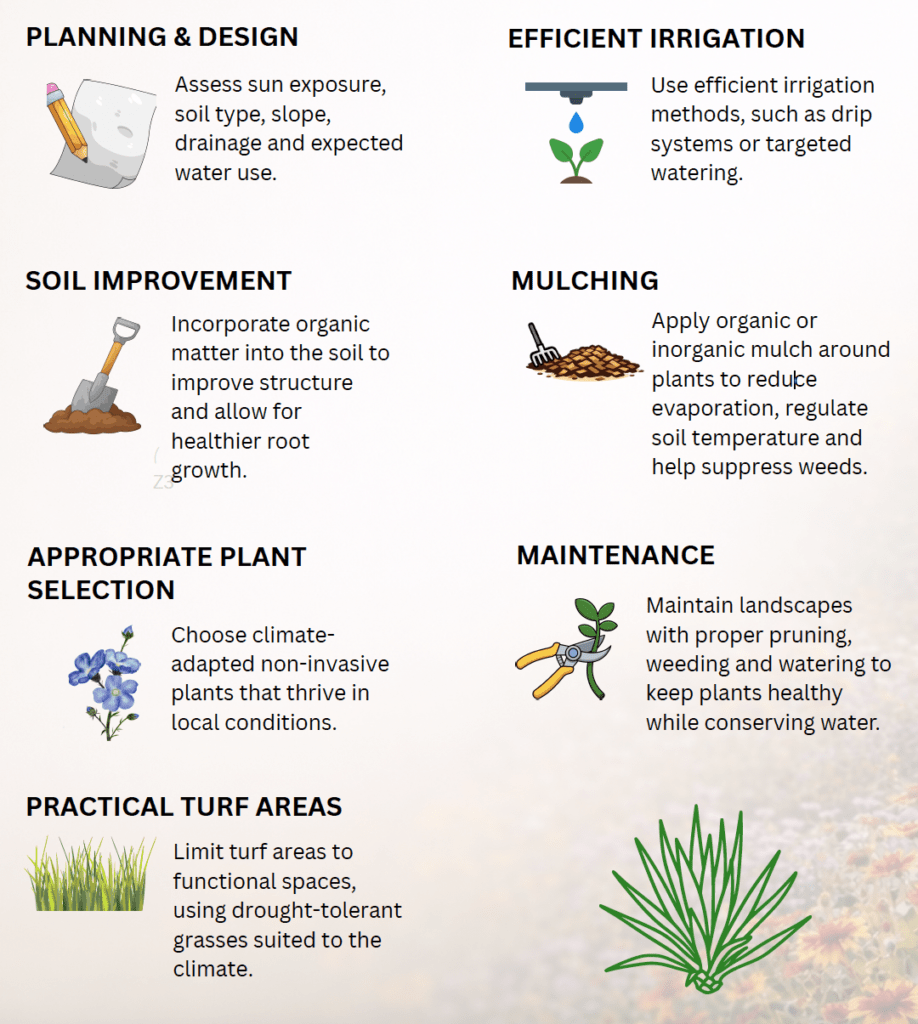
1. Planning & Design
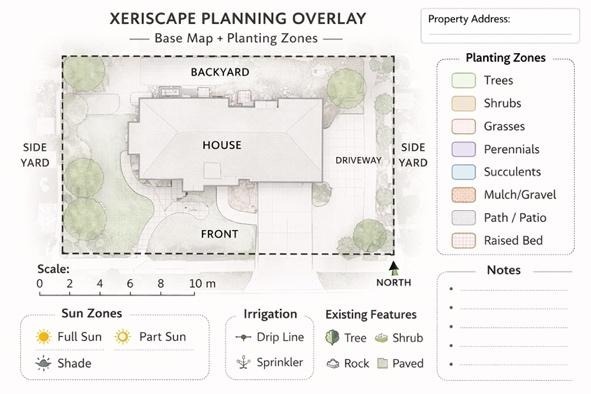
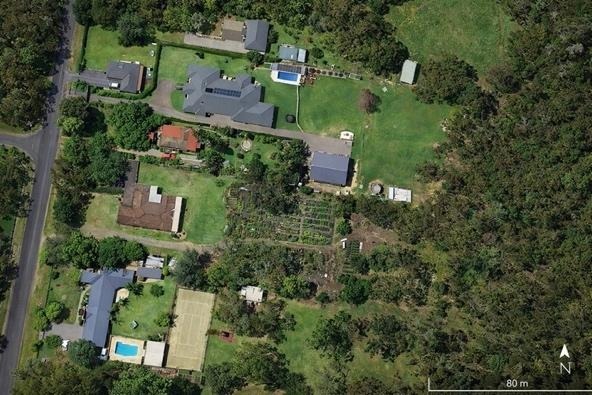
Effective xeriscape begins with site assessment. Evaluate sun exposure (particularly intense south-and west-facing areas), slope, drainage, soil type, and functional needs. Group plants according to water requirements (hydro-zoning). In the Thompson-Shuswap’s hot summers, thoughtful placement reduces stress and irrigation demand. Design for long-term maintenance and mature plant size.
2. Soil Improvement
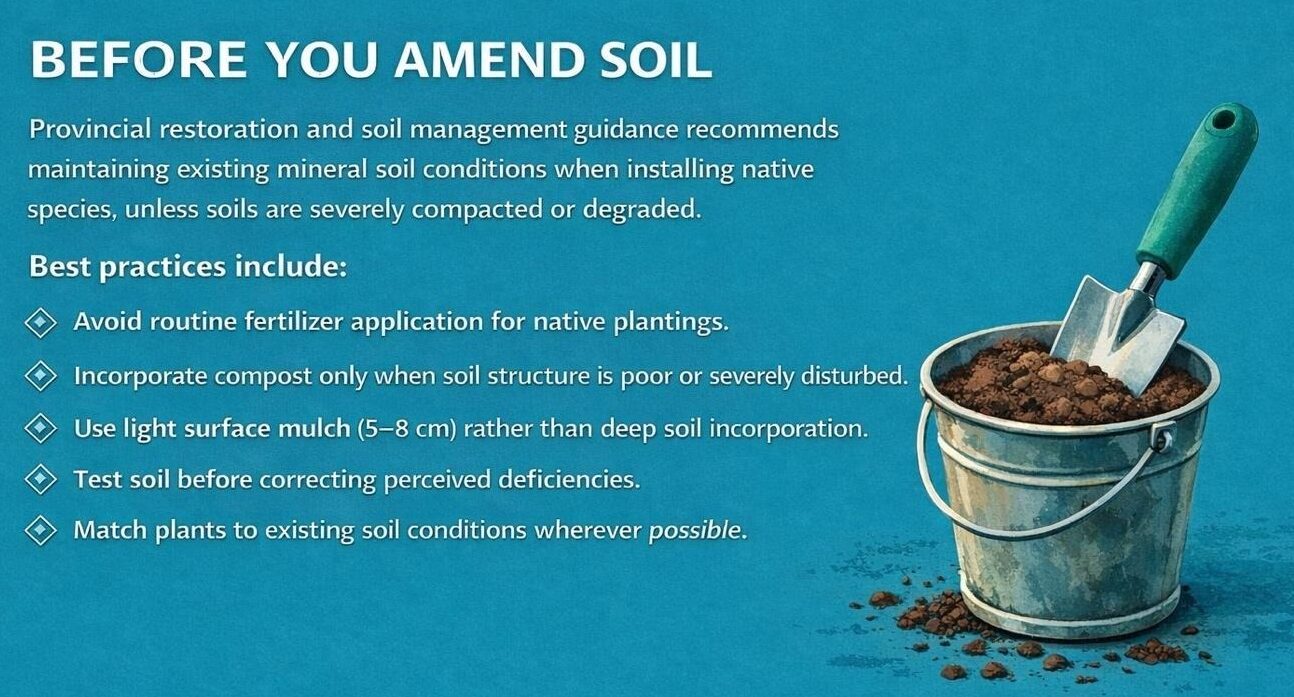
Many local soils are sandy, silty, or alkaline. Incorporating compost improves structure, microbial activity, and water retention. However, native plant areas should not be excessively amended, as many BC native species are adapted to lean soils. Healthy soil supports deep root growth and reduces water dependency.
3. Practical Turf Areas
Limit lawn to functional spaces such as play or gathering areas. Turf is often the highest water-use component of residential landscapes. Replacing unused lawn with climate-adapted plants significantly reduces irrigation needs.
4. Efficient Irrigation
Drip irrigation delivers water directly to root zones with minimal evaporation loss. Water deeply but infrequently to encourage strong root systems. Even drought-tolerant plants require consistent moisture during their first one to two growing seasons to establish properly.
5. Appropriate Plant Selection
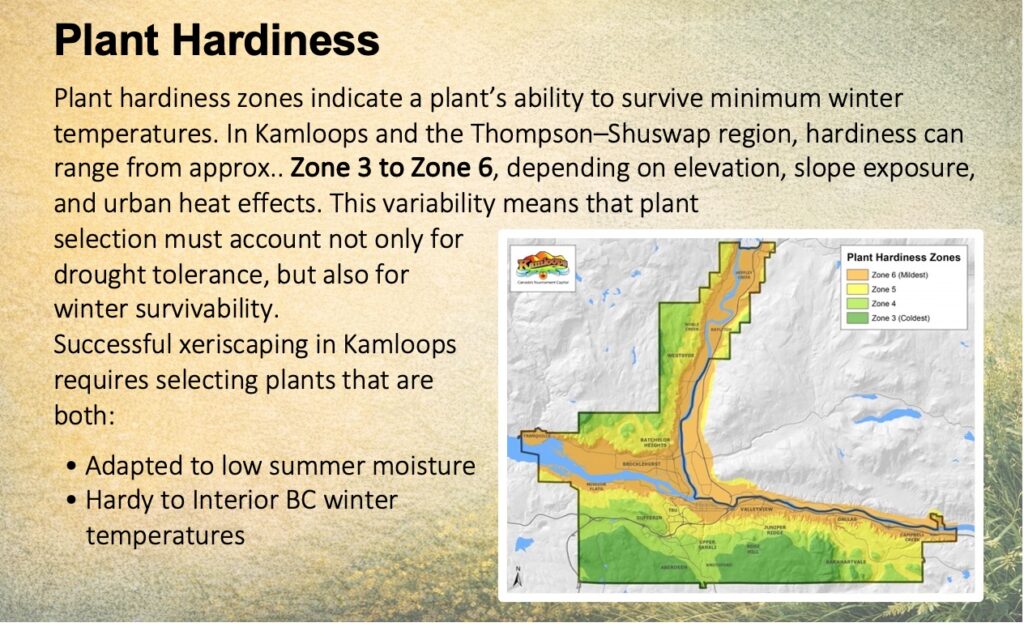
Select climate-adapted, non-invasive species suited to our hardiness zone and rainfall patterns. Incorporating . native plants supports pollinators and local ecosystems. Always verify plants are not listed as invasive in British Columbia.
- Suggested Plant Lists


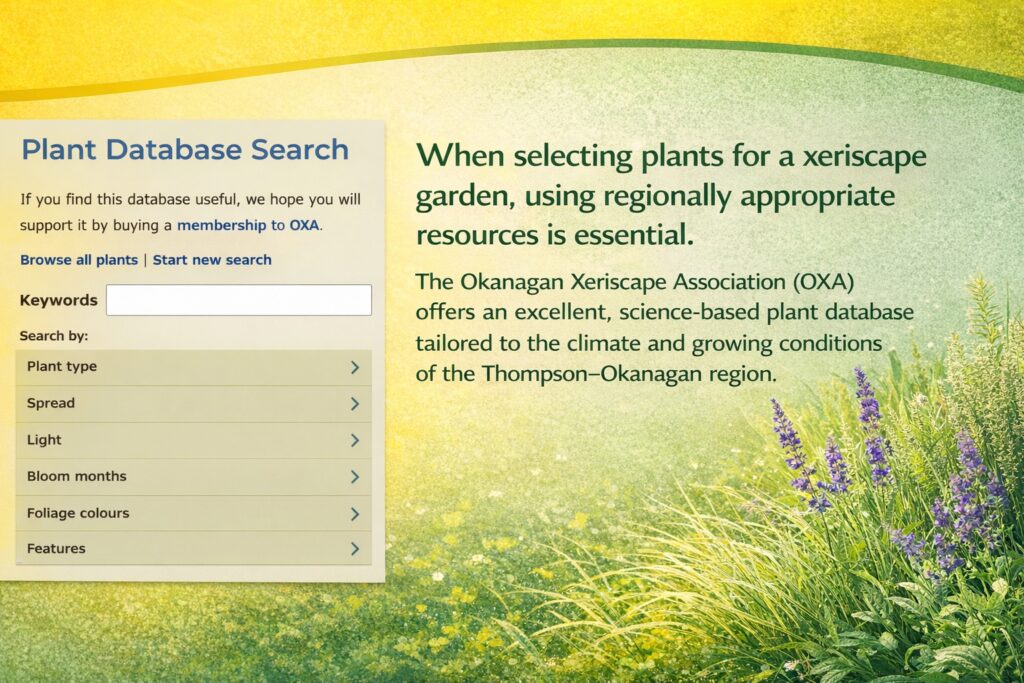
Select drought-tolerant plants that are not listed as invasive in British Columbia. Consult the Invasive Species Council of BC and local Thompson-Nicola invasive plant programs before purchasing unfamiliar species.
6. Mulching
Apply 5–8 cm (2-3 inches) of organic or inorganic mulch to reduce evaporation, suppress weeds, and moderate soil temperature. Avoid installing weed fabric beneath mulch; it can impede soil health and root development over time.
7. Maintenance
Xeriscapes are lower maintenance, not no maintenance. Regular weeding, seasonal pruning, irrigation adjustment, and monitoring for invasive species are essential for long-term success.
*Source: Okanagan Xeriscape Association. (n.d.). Xeriscape plant database and design resources. https://okanaganxeriscape.org
Water-Wise and Wildfire-Wise
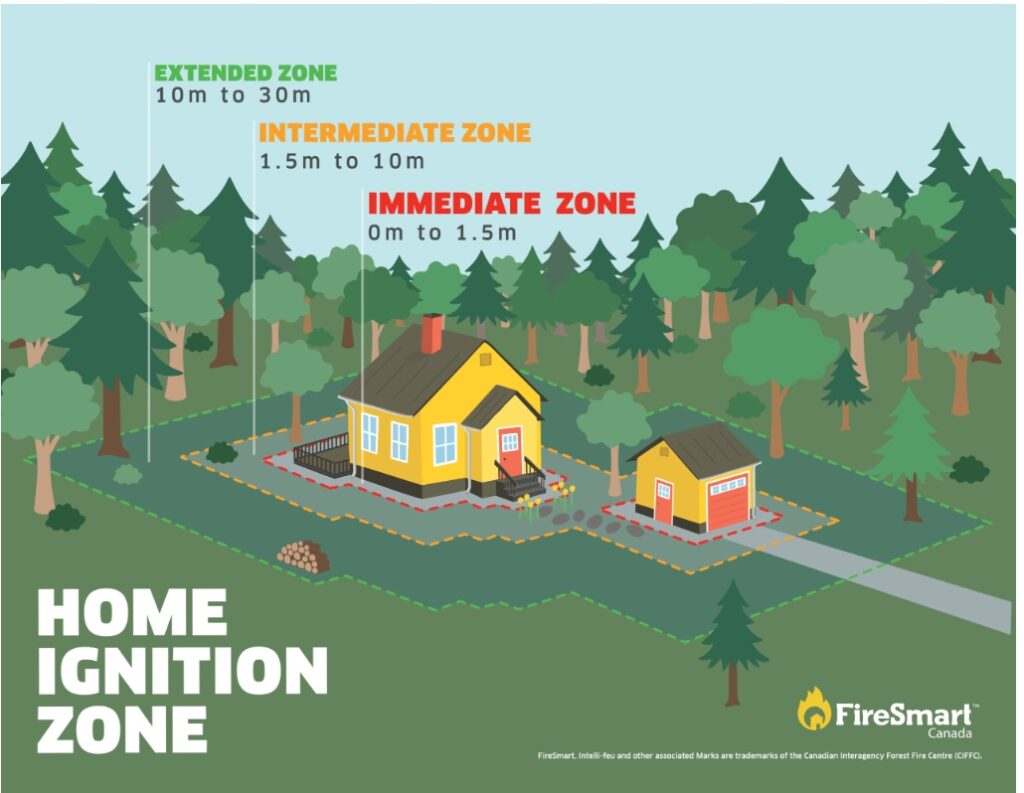
Xeriscape principles align closely with FireSmart BC landscaping recommendations. Waterwise landscapes can be wildfire-resilient landscapes when properly designed.
- Reduce continuous fuel by spacing plants appropriately.
- Avoid dense, resinous shrubs near structures
- Maintain the 0–1.5 m zone around buildings using non-combustible materials.
- Remove dead material and ladder fuels regularly.
- Use gravel or stone mulch near foundations instead of fine bark mulch.
Websites of Interest
BC FireSmart
Practical guidance for reducing wildfire risk through safer landscaping and home protection practices.
https://firesmartbc.ca
City of Kamloops – Xeriscape Resources
Provides local guidance and information for creating water-efficient landscapes in Kamloops.
https://www.kamloops.ca
Dr. Linda Chalker-Scott – Horticultural Myths
(Washington State University Extension)
Science-based articles that debunk common gardening myths using peer-reviewed horticultural research.
https://puyallup.wsu.edu/lcs/
Invasive Species Council of BC (ISCBC)
Works to prevent and manage invasive species through education, coordination, and provincial programs.
https://bcinvasives.ca
Okanagan Basin Water Board – Make Water Work
Encourages water conservation through drought-tolerant landscaping and responsible outdoor water use.
https://www.makewaterwork.ca
Okanagan Xeriscape Association (OXA)
Promotes water-wise gardening with regional plant resources, education, and a comprehensive plant database.
https://www.okanaganxeriscape.org
Thompson-Nicola Xeriscape Association (TNXA)
A local organization promoting sustainable, water-wise gardening across Kamloops and the Thompson-Nicola region.
Contact: tn.xeriscape@gmail.com