
Q. Is it possible to use red thyme as a groundcover?
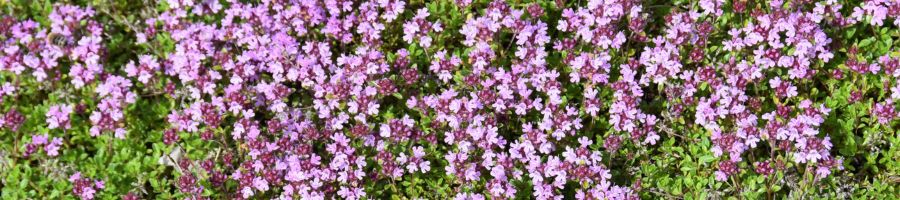
Red Creeping Thyme (Thymus serpyllum ‘Coccineus’) is a creeping dwarf evergreen shrub, growing to 10 centimetres (4 in) tall and native to Europe and North Africa. It has woody stems up to 10 cm long and a taproot and forms mat-like plants that root from the nodes of the squarish stems. The leaves are 3–8 mm long in opposite pairs, nearly stalkless, with linear elliptic round-tipped blades and untoothed margins. The plant sends up erect flowering shoots in summer. The flowers are 4–6 mm long and usually pink or mauve, rarely white. The upper petal is notched and the lower one is larger than the two lateral petals and has three flattened lobes which form a lip. Each flower has four projecting stamens and two fused carpels. The fruit is a dry, four-chambered schizocarp.
This tough, drought tolerant plant needs a sunny, well drained spot in the garden with neutral to alkaline soil (amendment with lime may be necessary as most west coast soils tend to be acidic). It will not thrive in a waterlogged location although it will require watering in hot weather until such time as the plant is established. The flowers are produced as a mass in late spring and early summer and highly attractive to bees and butterflies. This plant is perfect for rock gardens and container planting. It also is used to edge pathways and as a ground cover to soften landscaping around hard elements like rocks and planters. If planted between paving stones it will tolerate light foot traffic and release its scent when trodden on. The leaves may turn bronze in the winter.
When planting, space the plants about 20-30cm (8-12in) apart to allow them room to spread. Thyme prefers poor to moderately fertile soil, so avoid enriching the planting hole with too much compost or fertiliser. Due to the dense, mat forming habit of Thyme, it suppresses weeds as it spreads. After flowering, trim lightly to keep a neat appearance and encourage the growth to become dense. The plant can be pruned more severely in the early spring or late fall if it becomes too woody. Prune out thick, woody stems to encourage new tender growth. Good air circulation is necessary to prevent fungal infections so keeping the plant trimmed and avoiding over-watering, particularly if your garden has an irrigation system, will help to keep the plant healthy.
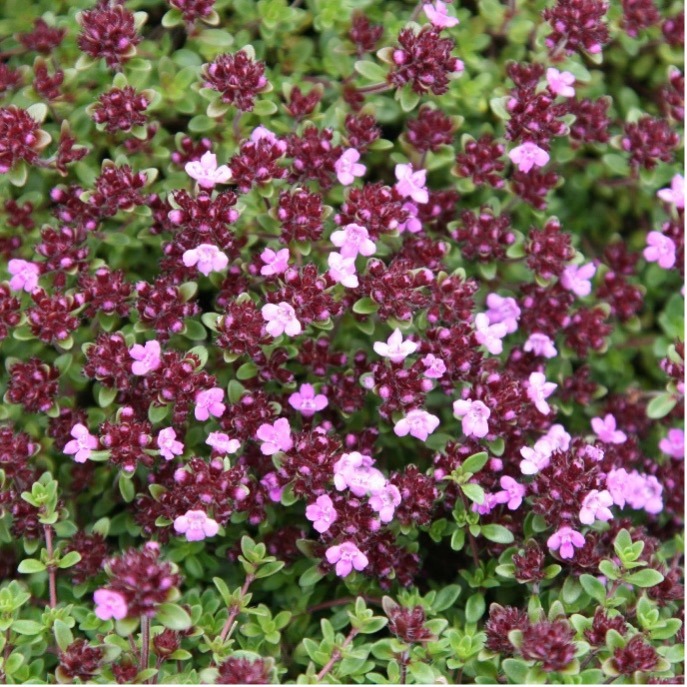
There are various types of red Thyme:
- Thymus serpyllum ‘Coccineus’ has bronze / green leaves and grows 3 inches tall (7-8 cm)
- Thymus x citriodorus ‘Spicy Orange’ has pink flowers and grows 1-2 inches tall (2.5 – 5.5 cm)
- Thymus pseudolanuginosus, also known as Wooly Thyme, is low growing and has very pale pink flowers.
In zones with cold winters, thyme is semi-evergreen, which means it will remain mostly green and keep its leaves but some branches may die. Fortunately, in our climate the Thyme plants are pretty hardy. If there is a threat of particularly cold weather or if the garden is at higher, cooler elevations then protect plants with a 2- to 3-inch layer of mulch.
Thyme plants are very resilient but can be susceptible to spider mites if summers are hot and dry, which seems to be the case increasingly in our west coast area. The mites can be washed off with a strong stream of water from a hose.
Sources
- https://www.rhs.org.uk/plants/251492/thymus-creeping-red/details
- https://www.inaturalist.org/taxa/322051-Thymus-serpyllum
- My own garden
Q. What are Cucamelons?
Melothria scabra is a member of the Cucurbitaceae family commonly known as the cucamelon, Mexican miniature watermelon, Mexican sour cucumber, Mexican sour gherkin, mouse melon, or pepquino. This vining plant is native to Central America and Mexico where it grows in forests and thickets. It is technically neither a cucumber nor a melon. In Canada it is usually cultivated as an annual for the fruit, which is eaten raw or pickled.
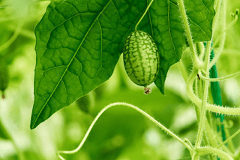
The vine grows 8-10 feet tall (2.5-3 metres) reaching maturity in 60-75 days. The leaves have three or five lobes with toothed edges and small hairs covering the upper surface. The fruits are small, about 1-1.6 inches (2.5-4cm) in length, olive shaped, green in colour with darker green stripes. The flesh is mildly sweet and taste like cucumber with a tinge of lime.
Sow 3-4 seeds 2cm (1″) deep in each spot you want a plant to grow. Thin to the strongest seedling. Space plants 23cm (9″) apart in rows 90cm (36″) apart or grow in large pots.
Cucamelons produce both male and female flowers on the same plant and the female flowers emerge first. The flowers are small and yellow and about 4mm (0.2 inches) in diameter and once the male flowers bloom the plant can self pollinate.
Cucamelons need a sunny spot in the garden with at least six hours of sunshine per day. Some shading may be required in very hot weather. They also need well draining soil which can be in the ground or in a large pot. Given the vining nature of the plant, a trellis or support will be needed. Like most cucurbits, regular watering is necessary although the roots must not become waterlogged. Fertilize at least once early in the growing season with a balanced 10-10-10 or 4-4-4 fertilizer to encourage vining growth then switch to a higher potassium and phosphorus formula, such as you would use for tomatoes, to stimulate fruit production.
The plants are less vulnerable to diseases that affect other cucurbits such as cucumbers, but are still susceptible to cucumber mosaic virus and also powdery mildew in humid, low airflow conditions.
Cut the fruits from the vine. Use a sharp pair of scissors or gardening shears to cut the cucamelons off the vine. Avoid pulling them as this could damage the plant.
Once harvested, store your cucamelons by placing them in a paper bag and keeping them in your refrigerator for up to one week. Pickling can help preserve them for several weeks. You can save seeds for next year. Choose a couple cucamelons and allow them to fully mature until about 2.5 cm (1″) long. Cut them in half to extract the seeds. Scoop out seeds and any surrounding pulp from the seed cavity. Place this mixture of seeds and pulp into a small bucket or jar with some water. The mixture needs to undergo fermentation for 1-3 days to remove the pulp from the seeds. When fermentation is complete, separate the pulp from the seeds and rinse and dry them. Put the seeds into a dated and labeled envelope.
Overwintering can be achieved if your cucamelons are planted in containers and have produced tubers in their roots. Plant roots develop tubers as storage vessels for energy and nutrients during the growing season. If your cucamelon plant’s roots have tubers, it is an indication that the outdoor temperature is too cold and the plant is going into hibernation. Moving your plant into a pot indoors can help it survive harsh winter conditions. The tubers can also be stored for perennial cultivation.
Sources
Sources: