
by Julie Cohen
Background
To date, Japanese beetles (Popillia japonica) have not been found on Vancouver Island, largely thanks to a concerted effort to contain their 2017 arrival in Vancouver. First detected in the False Creek area of Vancouver by the Canadian Food Inspection Agency (CFIA) during routine annual surveillance. Exactly how the beetles arrived in Canada is a mystery. Regardless, adult beetles are active flyers and can travel on clothing, vehicles, or other methods and can be transferred through soil and plant movements.
That is why the Japanese beetle is a federally regulated and quarantined pest in Canada under the Plant Protection Act and regulations. While the beetle was detected in the Metro Vancouver area for six years its initial discovery, the CFIA reports that none were found in Vancouver in 2024.
While the beetles are not yet considered established in the province, they have been discovered in other areas of B.C. About 25 kilometres east of Vancouver, the CFIA detected more than 500 Japanese beetles in Port Coquitlam. The agency also detected 11 beetles in Kamloops.PROBLEMS CAUSED BY JAPANESE BEETLES
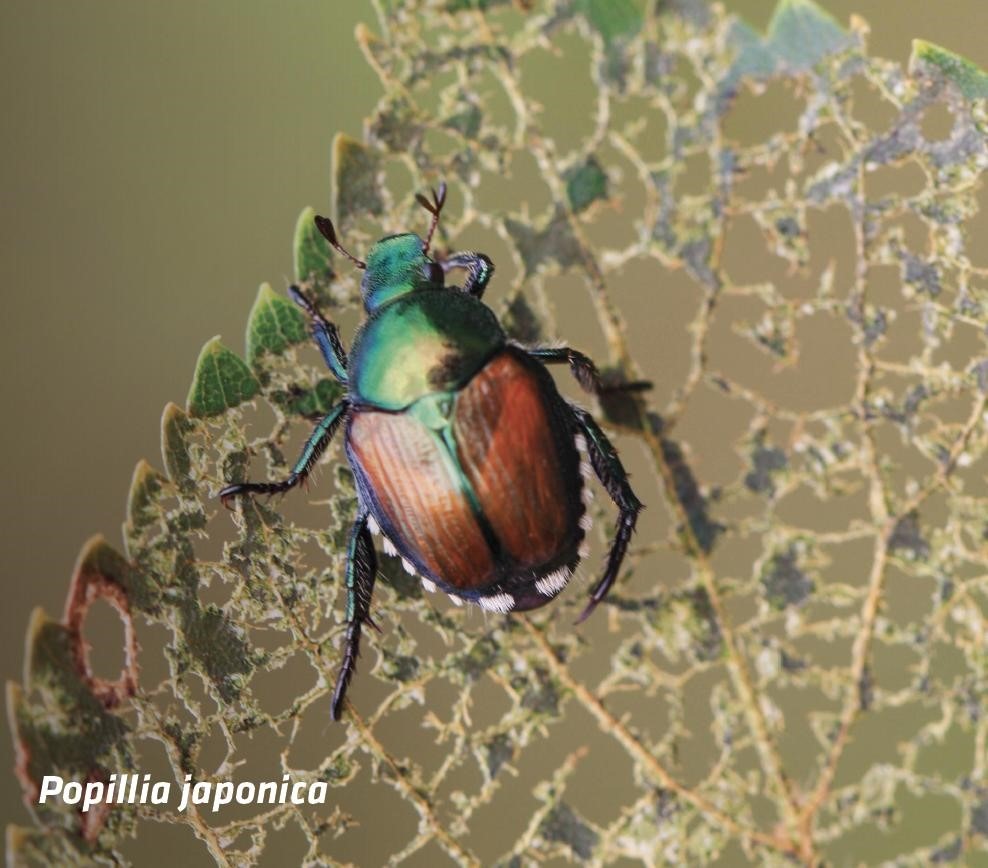
Within its native habitat, Japanese beetles are controlled by natural predators. In North America, they are a destructive pest, known for a voracious appetite and the ability to quickly defoliate plants by skeletonizing the leaves, damage landscapes, and reduce crop yield.
Adult beetles can cause extensive damage to more than 300 types of plants and crops, such as elm, maple, rose, apple, grape, zinnia, corn, asparagus, fruit trees (peach, apple, apricot, cherry, and plum) and berries (blueberries, raspberries, and blackberries).
Life Cycle
The Japanese beetle life cycle includes four stages: egg, larva, pupa, and adult. Unlike many other pests, the beetles cause damage during two life stages: larval and adult.
The larva (also called grubs) feed on fibrous root systems and prefer turf, but they will consume roots of other plants if populations are high. The damage caused by larvae will kill grass. Brown spots in grassy fields, visible as early as March, may indicate the presence of grubs. The larvae may also attract such predators as raccoons, skunks, and birds, which can cause additional damage to lawns and gardens as they dig and pull up turf looking for the calorie-dense grubs in winter and spring.
Identifying Japanese Beetles
Larvae have a C-shaped cream-coloured body and yellow-brown head with six prominent legs. There are several look-a-like beetle grubs, including European chafer beetle grubs. Japanese beetle grubs can be distinguished by the pattern created by fine hairs on their tail end (the raster pattern). However, a microscope is necessary for confirmation.
Adults are 10 mm long and 6 mm wide with metallic green heads and thoraxes and metallic copper-brown wing coverings with six distinct tufts of white hair around each side and back of the abdomen. Their flight period occurs from June 15 to October 15 when temperatures are greater than 21°C. Adults feed on flowers, fruits, and leaves, and females commonly lay their eggs in well-watered lawns.
Many other beetles are mistaken for the Japanese variety, including both native and invasive species. The Ten-Lined June Beetle (Polyphylla decemlineata) and the Golden Buprestid/metal wood-boring beetle (Buprestis aurulenta) are the most common native species mistaken for the
Japanese beetle. However, the Ten-Lined June beetle is substantially larger and the Golden
Buprestid more elongated than the Japanese beetle. Two invasive species — the European Brown Chafer (Amphimallon majale) and the Brown Marmorated Stink Bug (Halyomorpha halys) — are can also be mistaken for Japanese beetles.
Bibliography
https://bcinvasives/invasives/japanese-beetle/
https://metrovancouver.org/services/regional-planning/Documents/japanese-beetleguidebook.pdf
https://vancouver.ca/home-property-development/japanese-beetle.aspx
https://www.cbc.ca/news/canada/british-columbia/japanese-beetle-spread-1.7421081
https://inspection.canada.ca/en/plant-health/invasive-species/insects/japanesebeetle/regulated-areas