- Is Angelica archangelica edible? Is it a perennial?
- Do all types of boxwood (Buxus) smell? I want to buy the variety ‘Green Gem’ but don’t like the smell associated with boxwood.
Q. Is Angelica archangelica edible? Is it a perennial?
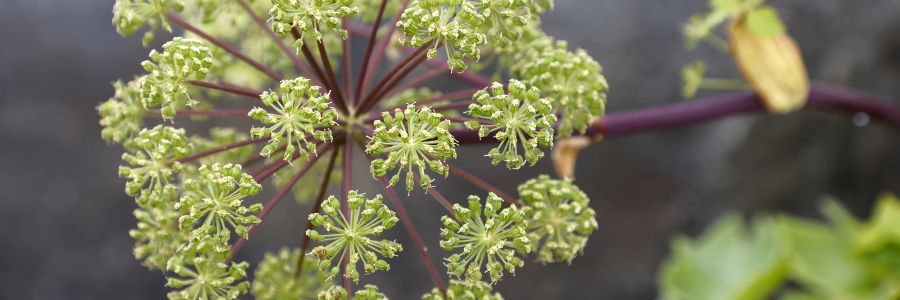
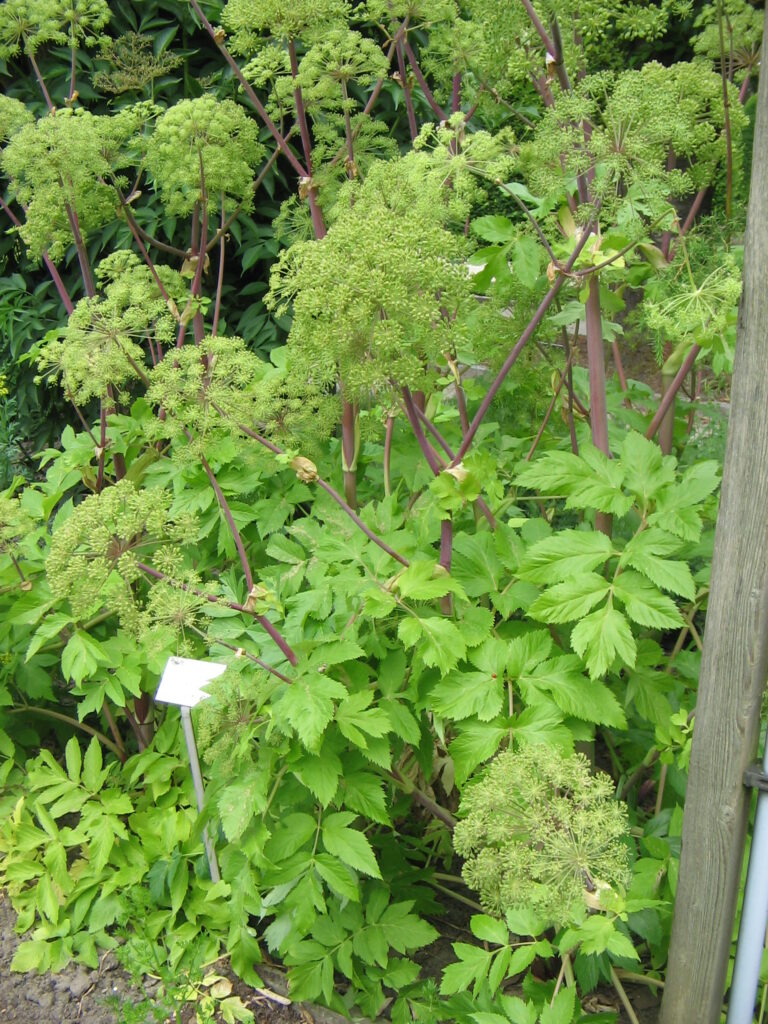
Angelica archangelica or Garden Angelica is generally considered a non-aggressive biennial in home gardens. A biennial plant is a flowering plant that takes two years to complete its biological life cycle. In the first year, it grows roots, stems, and leaves (rosette), then goes dormant. In the second year, it flowers, produces seeds, and dies. Grow in deep fertile soil, avoiding hot, dry positions. Staking may be needed in windy or exposed sites. The plant can be very variable in size but often reaches 3 to 6 feet tall and 2 to 4 feet wide with the right growing conditions. It is more likely to be perennial if prevented from setting seed which can be achieved by cutting off the seed heads. It is also worth noting that it can self-sow and spread in certain conditions, often requiring management of seed heads by removing them. Its close relative, Woodland Angelica (A. sylvestris), is considered highly invasive in parts of Eastern Canada, notes the New Brunswick Invasive Species Council. It is of considerable importance that you are planting the correct plant, archangelica not sylvestris.
Candied stems can be used as a garnish for cakes and desserts. When candied, the stems become a brilliant emerald green with a sweet slightly spicy flavour, often compared to licorice. These can be purchased commercially. People have used Angelica archangelica for its supposed medicinal properties – indigestion, quitting smoking, excessive urination at night, decline in memory and thinking skills, rheumatoid arthritis, and many other conditions. None of these uses are supported by any good scientific evidence. Further, the sap can cause skin irritation or blisters when exposed to sunlight, say the New Brunswick Invasive Species Council. This irritation can often occur with pets as well.
Sources
http://www.gardening.cornell.edu/homegardening/scenee2d2.html
https://www.gardenia.net/plant/angelica-archangelica-angelica
https://www.nbinvasives.ca/woodland-angelica
Photo: By Meneerke bloem – Own work, CC BY-SA 3.0, https://commons.wikimedia.org/w/index.php?curid=10640734
Q. Do all types of boxwood (Buxus) smell? I want to buy the variety ‘Green Gem’ but don’t like the smell associated with boxwood.
English boxwood (Buxus sempervirens ‘Suffruticosa’) is the most notoriously aromatic variety caused by the oils within the leaves and flowers. The fragrance is particularly strong when bruised, pruned, or in direct sunlight during periods of high humidity. ‘Green Gem’ is a Canadian hybrid, which is a cross between Korean boxwood (Buxus microphylla var. koreana) and English boxwood (Buxus sempervirens), specifically designed for hardiness in colder climates.
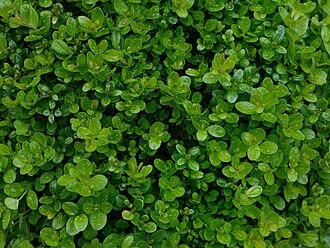
‘Green Gem’ shares the characteristics of all boxwoods, evergreen, fast-growing, prunable, deer and rabbit resistant, and tolerant of part shade or full sun, with consistent watering.
However, to be completely sure of no, or very limited, fragrance it is advisable to plant Asian boxwood varieties (Buxus microphylla), such as ‘Green Mountain’ or ‘Green Velvet,’ which generally do not have the pungent odor. ‘Green Velvet’ is the more compact of the two varieties, good for low hedges or foundation planting, it remains green throughout the winter and is easily prunable. It is important to keep an eye out for common boxwood issues, such as box sucker, scale, spider mites, and most importantly boxwood blight which has become a significant problem in our region. Also, it is highly recommended to use BTK (Bacillus thuringiensis kurstaki) for control against caterpillars.
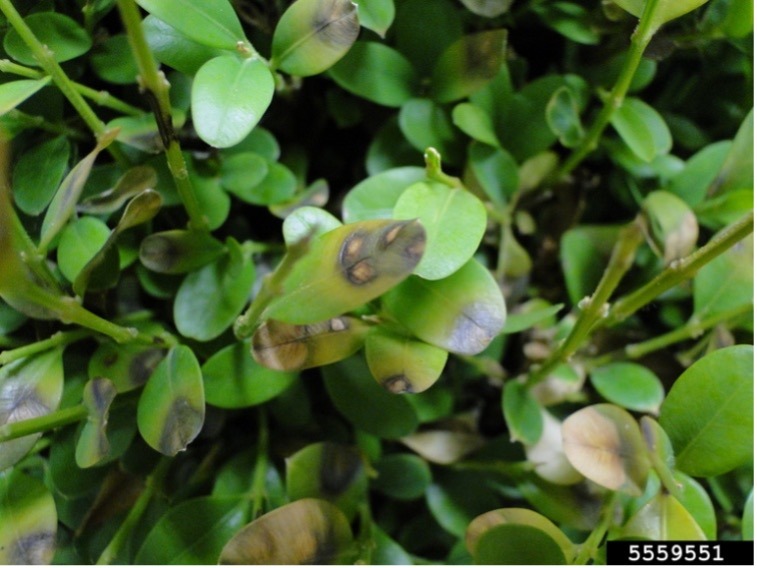
Boxwood blight a fungal disease that stays in the soil and affects the aboveground parts of the plant which causes leaf spots, rapid defoliation of the plant, and eventually death. The absence of lower leaves is the easiest way of distinguishing boxwood blight from the other common problems of boxwood. Fallen leaves may serve as a ready source of the disease, spreading it as the leaves are moved about blown by the wind or leaf blowers, or dumped in the compost pile. The pathogen is extremely resilient, capable of surviving for years on buried leaf debris.
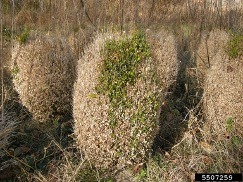
Missouri Botanical Garden.org – Boxwood Blight
There are other small shrubs which can be planted instead of boxwood, more trouble free and with a similar evergreen look for small hedges and foundation plantings. The most similar in appearance are Inkberry holly and Pyracomeles Juke Box. It would be wise to investigate these shrubs before you finally decide on boxwood.
Sources
https://www.gardenia.net/plant/buxus-green-velvet
https://www.thespruce.com/densa-inkberry-holly-versatile-native-option-2131850
Creative Commons Photo: Böhringer Friedrich. CC BY-SA 3.0 AT, via Wikimedia Commons