
CLINIC REFERENCE – VMGA – July 10/2026
A native pest of Asia, the brown marmorated stink bug (Halyomorpha halys) has been in North
America for 25 years and in British Columbia for the past 10 years. First seen in Chilliwack in
2016, it is now established in urban areas of southwest British Columbia, including Vancouver,
the Fraser Valley, Kelowna, and Vancouver Island. H. halys is designated as a management
species by the BC Provincial Priority Invasive Species List.
Damage
The invasive bug attacks tree fruits, berries, grapes, vegetables and ornamental plants. Its
straw-like mouthparts inject digestive juices directly into plant tissue, which causes bruises and
blemishes on unripe fruits as well as a wound that may become infected, making fruits
unappealing to eat.
Hosts
Hosts include backyard Asian pears, apples and apricots, hazelnuts, wild chokecherries, maple,
lilac, honey locust, tree of heaven, mountain ash, ash, shiny cotoneaster, catalpa, magnolia,
snowberry, scarlet firethorn, rose, rose of Sharon, cedar, Virginia creeper, sumac, hops, runner
bean, Oregon grape, privet, gingko, handkerchief tree, oak, ornamental prunus, clematis,
sunflower, thimbleberry and elderberry.
Characteristics/Identification
The brown marmorated stink bug gets its name from the strong odour — a pungent coriander-
like smell — it releases when crushed or sometimes simply when handled or injured.
Adults are 1.5 cm long with a distinct shield shape. They can be distinguished from other
species of British Columbia stink bugs by the two small, white stripes on the ends of their
antennae, a single white stripe on each leg, and the white and black spots at the base of their
abdomen.
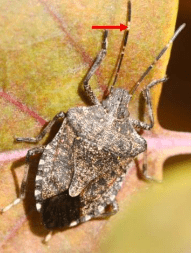
Immature stink bugs look very similar to full adults but lack wings. Like the adults, they have
two small, white stripes on their antennae, a single white stripe on each leg, and a fringe of
white and black spots at the end of their abdomen.
Brown marmorated stink bugs look similar to several other species, including the rough stink
bug (Brochymena spp.), which lacks the white stripes on its legs and antennae, and the western
conifer seed bug (Leptoglossus occidentalis), which has flared hind legs and also lacks the white
stripes on its antennae.
Also confused with native spined soldier bugs, which hunt pest insects, which eat 50 or more
per week, brown marmorated stink bugs can be distinguished from soldier bugs by looking at
the shoulders. Brown marmorated stink bugs have smooth shoulders, while soldier bugs have
sharp shoulder spines.
Control
The province recommends destroying brown marmorated stink bugs, and there are a several
ways to do that. Low numbers can be removed by hand (use a paper towel to absorb any odor),
sweeping or a shop vacuum. It’s important to prevent entry into homes by sealing off any
access points as they seek warm overwintering sites inside buildings. They don’t like water, so
dropping them into a bucket of soapy water will kill them.
Reproduction
From June to August, stink bugs lay barrel-shaped eggs in clusters of 5 to 50 eggs on the
undersides of leaves of many different types of plants. They can be a variety of shapes, colours,
and sizes, but their total cluster size is almost always smaller than a dime. The best way to look
for them is just to turn over leaves. Predators such as spiders, ladybugs, red velvet mites, and
lacewings will feed on brown marmorated stink bug eggs.
Enemies
A non-native natural enemy of the invasive stink bug is a tiny parasitic wasp (Trissolcus
japonicus) that attacks its eggs. The samurai wasp originates from the same parts of Asia where
the stink bug is native and was likely brought over accidentally along the same routes.
This wasp is now helping to control brown marmorated stink bug populations in British
Columbia. The provincial Ministry of Agriculture and Food is looking for volunteers to collect
eggs of this species and related native stink bugs as part of a scientific research project which
will determine if the eggs have been parasitized by wasps.
Report Infestations
If you find stink bug eggs, send a picture and a description of the eggs, including the date,
location, and what plant they are on to: https://forms.gov.bc.ca/industry/report-
brownmarmorated-stink-bug. Then place the eggs in a small sealed container. The Ministry will
respond to you confirming whether they are stink bug eggs, and if they are, will email
instructions about how to send them.
Bibliography
https://www2.gov.bc.ca/gov/content/industry/agriculture-seafood/animals-and-
crops/plant-health/insects-and-plant-diseases/tree-fruits/brown-marmorated-stink-bug
https://bcinvasives.ca/invasives/brown-marmorated-stink-bug/
https://www.timescolonist.com/animal-stories/find-stink-bug-eggs-bc-scientists-want-to-
hear-from-you-8589317
https://www.cbc.ca/news/canada/british-columbia/stink-bug-concerns-1.6613392