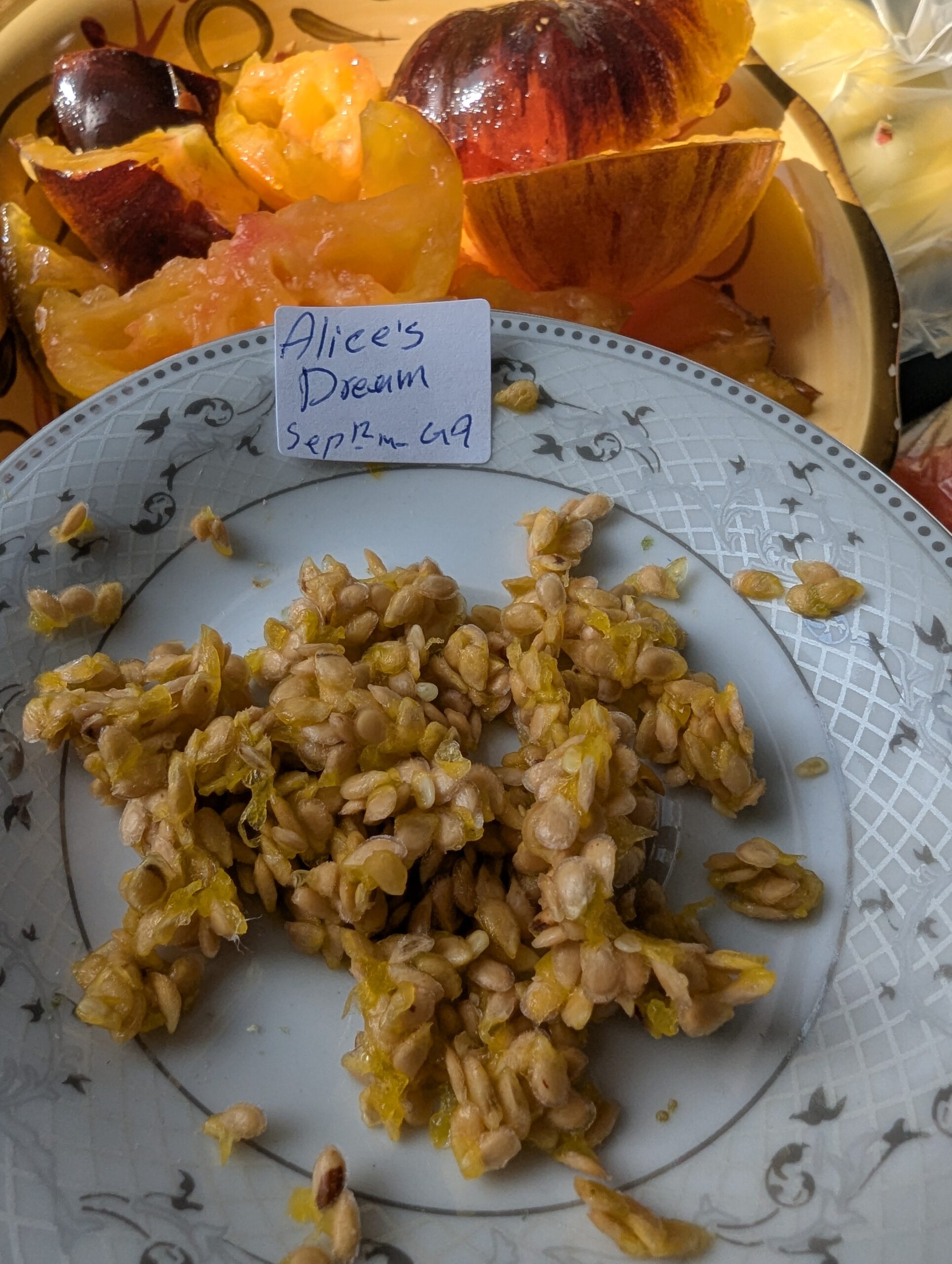
By late summer, my kitchen counter becomes an extension of the garden.
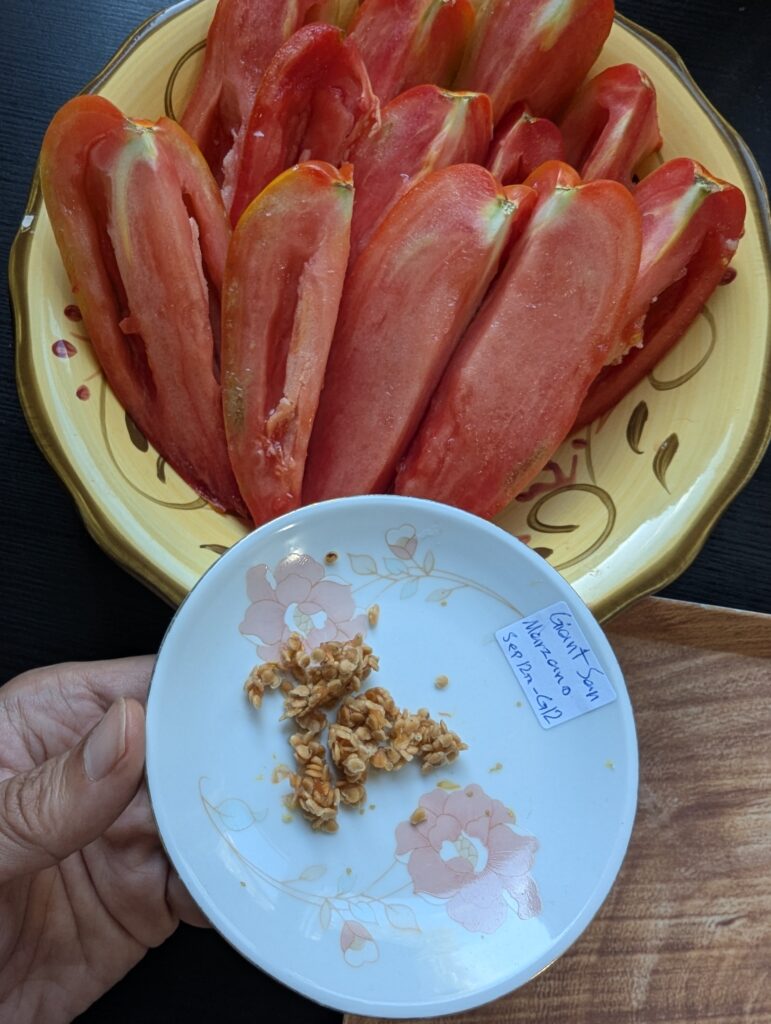
Tomatoes arrive one or two at a time. I cut one open, eat most of it, save the seeds, write down the variety, and leave the seeds to dry.
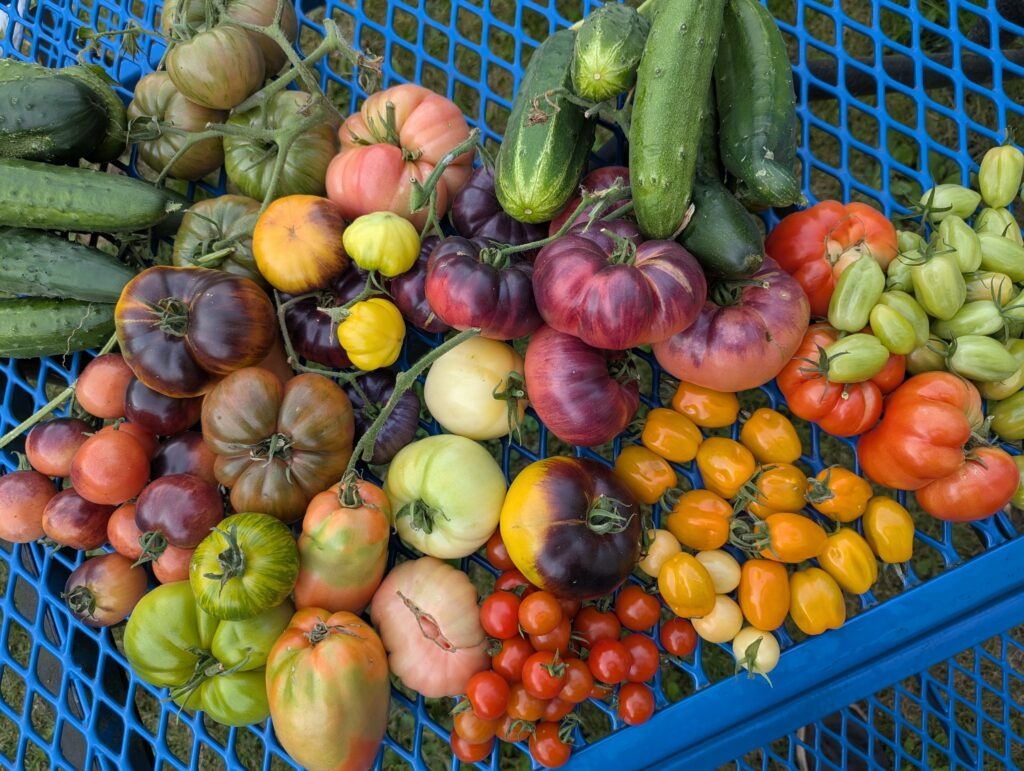
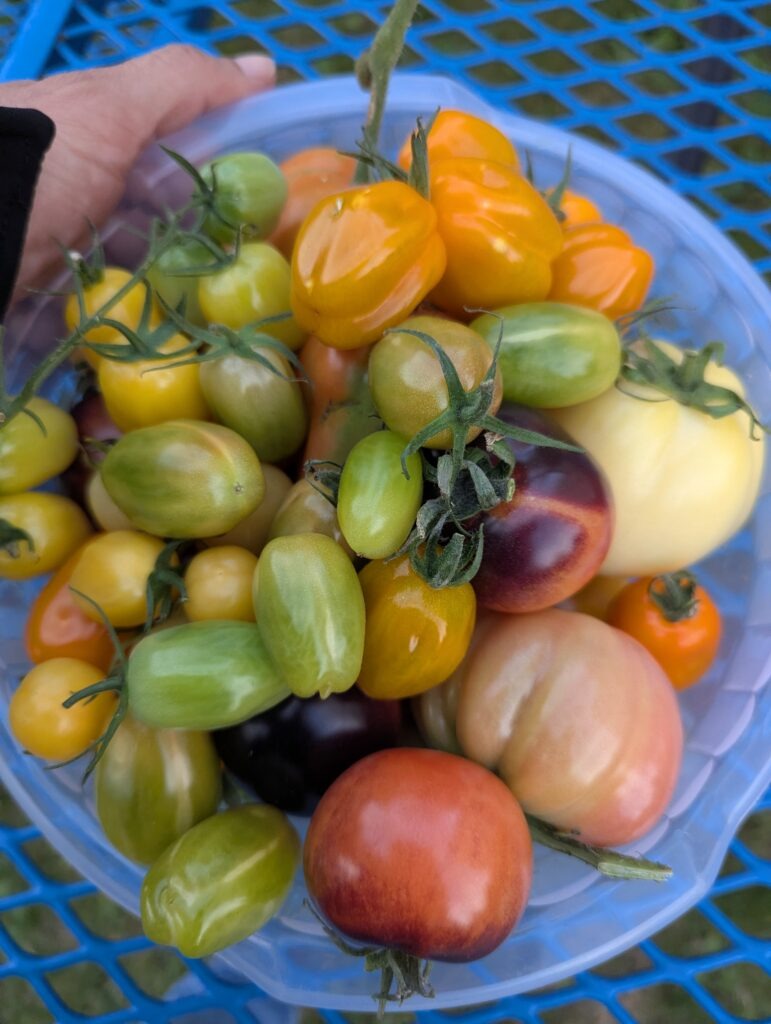
This year, I grew twenty-one varieties of tomatoes.
If I fermented every batch of seeds for three days, I would eventually have a collection of small containers at different stages of fermentation covering the kitchen.
The fruit flies in Vancouver would probably be delighted.
I would not.
So I don’t ferment my tomato seeds.
—
This is not what many seed-saving instructions tell us to do.
The standard advice for tomatoes is often to remove the seeds with their surrounding gel, place them in a container, allow them to ferment for several days, rinse them, and then dry them.
There are good reasons for this method. The gelatinous material surrounding tomato seeds contains compounds associated with inhibiting germination while the seed remains inside the moist fruit. Fermentation breaks down that coating and can also help reduce some seed-borne pathogens.
I know the method.
I have used it.
I simply stopped assuming that knowing a method meant I had to keep using it.
—
My method developed because of necessity.
I grow many tomato varieties, and they do not all ripen on Tuesday afternoon when I have decided it is time to save seeds.
One tomato is ready today.
Another two days later.
Three more the following week.
I bring them home from the garden as they ripen and collect the seeds individually.
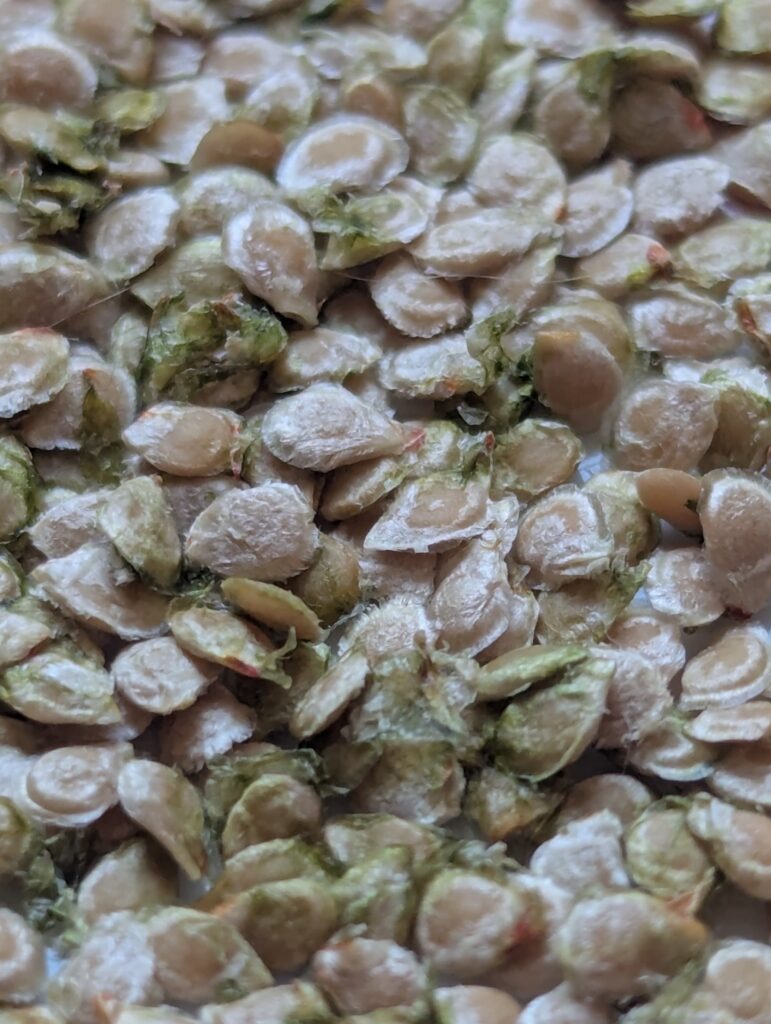
Instead of fermenting them, I separate and dry them directly. After the surface moisture has disappeared, I leave them considerably longer to make sure they are completely dry before storage.
Then I label them and put them away.
It is simple.
More importantly, it works for the way I garden.
—
I did not arrive at this method because someone told me it was better.
I arrived at it by repeating it.
I germinate my own saved seeds the following season, so eventually the seeds themselves tell me whether what I did worked.
With batches of tomato seed that I have dried directly, I have repeatedly seen extremely high germination — sometimes around 99 percent.
When I have fermented seed from plants whose directly dried seeds germinated at approximately that level, I have sometimes seen germination closer to 80 percent.
That is an observation from my own seed-saving practice.
It is not a controlled scientific experiment.
Temperature, seed maturity, handling, fermentation time and growing conditions can all affect the result. I would not take what happened on my kitchen counter and declare that fermentation is therefore wrong.
But I would not ignore what happened on my kitchen counter either.
That distinction matters to me.
—
Gardening has an unusual relationship with instructions.
We need them.
Someone has already spent a lifetime discovering things that would be foolish for each of us to rediscover independently.
I read those instructions.
I learn from them.
But eventually every instruction arrives somewhere.
Mine arrive in Vancouver.
They arrive in a garden with cool nights, long periods of rain, unpredictable springs and summers that do not always behave the way the seed packet seems to expect.
They arrive in my hands.
Then observation begins.
—
I first became particularly interested in this while growing tomatoes from seed that had come from Kelowna.
The first generation did not perform particularly well for me in Vancouver. Only about twenty percent of the plants gave me what I considered successful fruit production.
I saved seeds from the plants that performed well.
Then I planted them again.
In the second generation, I observed something different. Roughly sixty percent performed successfully.
I selected again.
By the third generation, more than ninety percent of the plants were producing successfully under my growing conditions.
I find that fascinating.
I am careful about what I claim from it. This was my garden, not a controlled trial. One Vancouver summer is not identical to the next. Temperature changes. Rainfall changes. Soil changes. My own gardening changes.
But selection changes things too.
When I repeatedly save seed from healthy plants that mature and produce successfully under the conditions I actually have, I am no longer choosing randomly. I am asking a question every season:
Which of you can do this here?
Then I save the answers.
—
There is nothing particularly impressive about the appearance of my saved seeds.
They do not arrive in glossy packets.
There is no photograph of a smiling person holding a basket overflowing with flawless tomatoes.
Sometimes there is only a small package, a handwritten name and a year.
But those seeds have something the photograph cannot show.
They have a history here.
They have been planted in Vancouver soil.
They have experienced Vancouver nights.
They have met our rain, our strange springs, our short stretches of heat and the particular mistakes of one Vancouver gardener.
Some have failed.
Some have stalled.
Some have produced beautifully.
And I have kept watching.
—
This is one of the reasons seed saving interests me so much.
Saving a seed sounds like an act of preservation.
Sometimes it is.
If I love a tomato, I want to grow that tomato again.
But after several seasons, I began to think that saving seeds can also be an act of exploration.
I am not only preserving what a plant was.
I am asking what it might become.
—
Cucumbers taught me this in another way.
A cucumber for eating and a cucumber for seed are almost two different things.
The cucumber we want for the kitchen is generally harvested young.
The cucumber I want for seed stays much longer.
I wait.
The fruit becomes large. Its colour changes. Depending on the variety, the skin may become yellow or orange. It passes the stage at which most people would want to eat it.
That is precisely the point.
I have sometimes left a mature cucumber for another week or so after harvest before removing its seeds.
Seed saving changes the way I look at the fruit.
What appears overripe to the cook may be exactly what the seed saver has been waiting for.
There is another complication with cucumbers: unlike tomatoes, they are readily cross-pollinated by insects. If several compatible varieties are flowering nearby, the cucumber I eat this year may look perfectly normal while the seeds inside it contain a genetic surprise for next year.
That possibility has to be understood.
It does not necessarily have to be feared.
—
Perhaps this is where my approach to gardening differs most from following a set of instructions.
I like knowing what is supposed to happen.
I also like discovering what actually happens.
Those are not always the same thing.
A university hundreds or thousands of kilometres away can give me valuable information about seed physiology, disease, pollination and storage. I would be foolish not to use it.
But that university cannot stand in my garden for three successive summers.
It cannot tell me which individual tomato plant kept producing when the others stalled.
It cannot notice which cucumber handled my particular corner of Vancouver better than its neighbours.
That part belongs to the gardener.
Local knowledge has to be made locally.
—
This does not mean abandoning science.
To me, it means doing the opposite.
Observe.
Record.
Repeat.
Compare.
Question your own conclusion.
Try again next year.
If the result disappears, perhaps it was chance.
If it returns, pay attention.
If it returns again, pay closer attention.
A garden gives us thousands of small experiments, although most of them are far too uncontrolled to deserve the name scientific experiments.
They are observations.
And observations, repeated carefully enough, can tell us what question we should ask next.
—
I sometimes think about all the instructions travelling between gardeners.
A gardener somewhere else tells a Vancouver gardener when to sow.
Another tells us how long to ferment.
Another tells us which variety should perform best.
There is nothing wrong with listening.
But if gardeners in Vancouver do not develop knowledge from what happens in Vancouver, someone somewhere else will always be telling us how our gardens are supposed to behave.
I would rather listen to both.
I want the accumulated knowledge.
And I want the tomato plant in front of me.
—
So every year I save more seeds.
Some are ordinary.
Some come from plants I am watching carefully.
Some are already several generations into their life in Vancouver.
They are small enough to disappear between my fingers.
There is no smiling gardener on the packet.
No basket of perfect vegetables.
Usually just a name.
A year.
Perhaps a note.
And a possibility.
That is enough reason for me to plant them again.
🖊️📷 Ted M. 🌱VMG Student